



 Letters set adrift at sea, and a barrel on an uninhabited island that has worked as a post office for more than two centuries. The story of paper that travels without a postman.
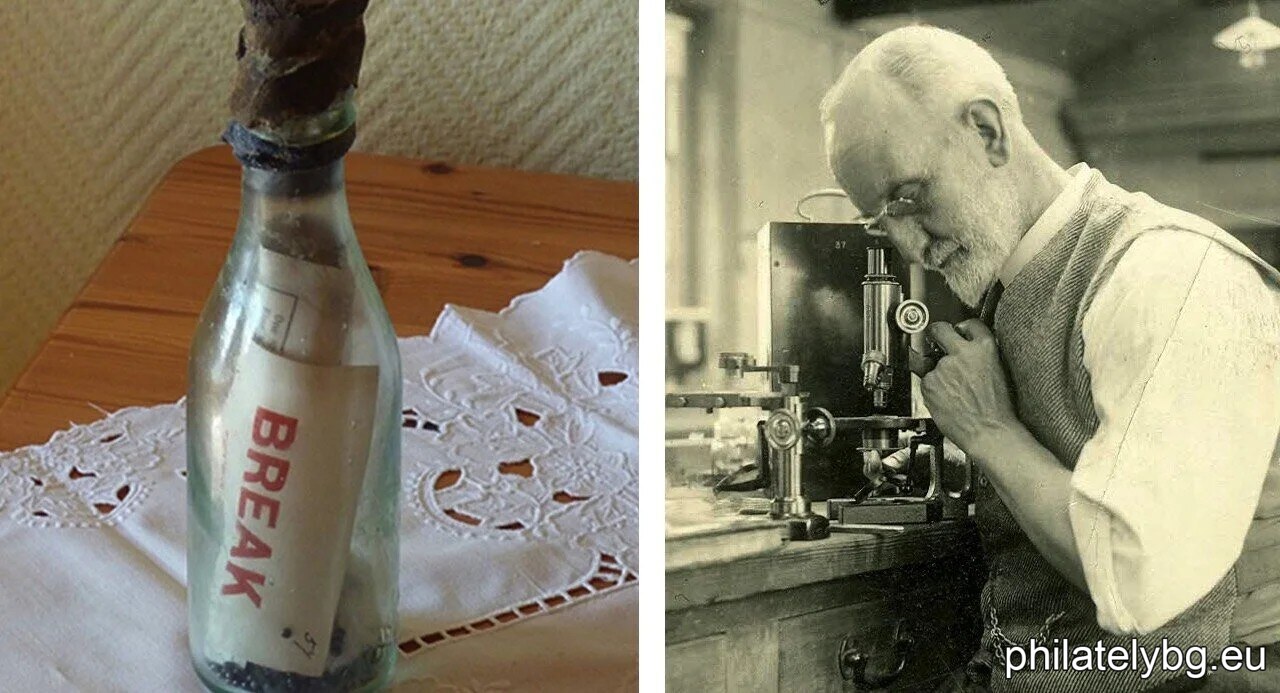
In April 2015, on the beach of the German island of Amrum in the North Sea, the retired postal worker Marianne Winkler found an old bottle. Inside was a note saying “Break the bottle”, and under it a postcard asking the finder to return it to the Marine Biological Association in Plymouth, England, and promising a reward of one shilling. The bottle had been thrown into the sea on 30 November 1906 and had traveled for 108 years, 4 months and 18 days. In 2016 Guinness World Records confirmed that it was the oldest message in a bottle ever found. Winkler returned the postcard and received the promised shilling. The story is interesting to a philatelist because it is a postal one: a letter travels for more than a century until a stranger returns it to the address.
The bottle was not a sentimental gesture but a scientific experiment. Between 1904 and 1906 the British biologist George Parker Bidder dropped about 1,020 weighted bottles into the southern North Sea to trace the bottom currents. The bottles were made to float a little above the seabed, where they were most likely to be caught in fishermen’s nets. Each held a card in English, German and Dutch asking the finder to fill in where it was found and the name of the ship and to return it to the association in Plymouth, for which a shilling was paid. In this way the postcard in the bottle worked as a prepaid postal service carried by the current. Bidder concluded that the bottom currents of the North Sea flow from east to west.
How many of these letters arrive? Bidder reported that about 55 percent of the bottles were hauled up by fishermen, and the association’s spokesman Guy Baker speaks of about half. That is a high rate, which is explained by the reward and by nets that fish close to the bottom, but this is only an interpretation. The association says that for many years no bottle had been returned and nobody remembers when the last one was, so the find of 2015 was a surprise. Other experiments are more modest: in a study with 75,000 yellow plastic “jellyfish” for the seabed, only about 19 percent were returned. The US Coast and Geodetic Survey released bottles from 1846 to 1966, using bright pink cards to attract the attention of finders. For ordinary bottles that people throw for fun, no reliable statistic appears in the sources used.
Many legends surround messages in bottles. According to one, the Greek philosopher Theophrastus released bottles around 310 BC to prove that the Atlantic Ocean flows into the Mediterranean. Some authors describe this as fact and others as myth. More famous is the story that Queen Elizabeth I appointed an “Uncorker of Ocean Bottles” and forbade everyone else from opening bottles on pain of death, because they might contain secret messages from spies. But several researchers and museums say that no such post ever existed and that the story comes from Victor Hugo’s 1869 novel. It should therefore not be taken as historical fact.
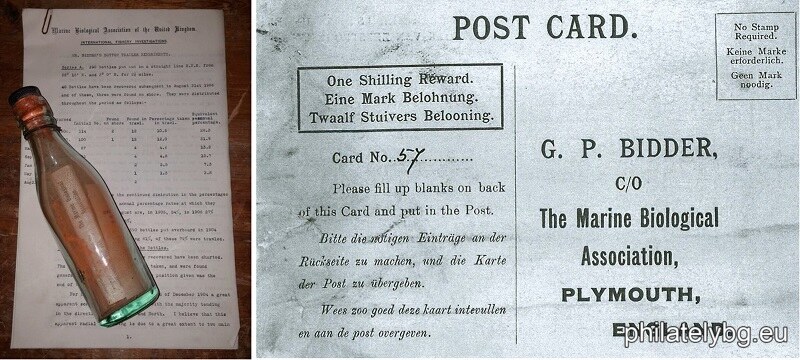 There is another post without ships and without stamps – the barrel on Floreana Island in the Galápagos. According to tradition, in 1793 Captain James Colnett of the ship “Rattler” left a wooden barrel on the shore in which whalers could leave letters for home, and any ship heading the right way would take them and deliver them. The account is not entirely certain: one specialist source says that Colnett is often wrongly regarded as the founder and that early descriptions speak of a box, not a barrel. What is certain is that the custom survives: the barrel has been replaced, and tourists look through the letters and take those addressed near their home and deliver them in person. On the island stamps are not needed and do not even work, and local guides say that sticking a stamp on a letter is cheating. In the old days some letters arrived after years, and for others it was not known whether they had arrived at all.
For the collector this is a special field. Mail that moves outside the post leaves few official traces. For this reason the sources used contain no reliable data on prices or collectors’ catalogues of messages in bottles or letters from the barrel. There are related failures that explain why this way of carrying mail is risky: the zinc balls “Boules de Moulins”, launched into the Seine during the siege of Paris, did not reach the city, and the last were taken from the river only in 1954. The risk in all these forms is the same: the item depends on the current, the weather and the goodwill of a stranger.
So how many letters really arrive? The answer depends on who sends the letter and with what purpose. In an organized scientific experiment with a reward for the finder and nets along the bottom, about half come back, but that requires serious preparation. For bottles thrown by casual people there is no reliable percentage. What is certain is this: a letter sent in 1906 by a man who believed in the current reached its address through a retired postal worker. The figures for returns, years and the origin of the legends differ among the sources and are therefore given as approximate.
Sources
Smithsonian Magazine, “Oldest Message in a Bottle Ever Found” – the throwing on 30 November 1906, the journey of 108 years, 4 months and 18 days, the find by Marianne Winkler – https://www.smithsonianmag.com/smart-news/oldest-message-bottle-ever-found-180958875/
National Geographic, “Century-Old Message in a Bottle Returned to Sender” (25 August 2015) – George Parker Bidder’s experiment, 1,020 bottles, about half returned – https://www.nationalgeographic.com/science/article/150825-message-bottle-lego-rubber-ducky-drifter-oceans-currents-science
Newsletter.co.uk, “Oldest bottle note in world confirmed” and Soundings Online – the Guinness confirmation, Guy Baker’s remarks that no bottle had been returned for many years – https://www.newsletter.co.uk/news/oldest-bottle-note-world-confirmed-1247352 and https://soundingsonline.com/?p=16314
Message in a Bottle Hunter, “Message in a Bottle Myths” and Mariners’ Museum, “Top #iamaMariner bottled note stories” – on the myth of the “Uncorker of Ocean Bottles” and Victor Hugo’s novel – https://messageinabottlehunter.com/message-in-a-bottle-myths/ and https://www.marinersmuseum.org/2018/09/message-in-a-bottle/
National Geographic, “This Is the World’s Most Unusual Post Office”, Visit Galapagos and Old Salt Blog – the barrel on Floreana Island, the tradition – https://www.nationalgeographic.com/travel/article/galapagos-post-office-bay, https://www.visitgalapagos.travel/visitor-sites/post-office-bay-galapagos-islands.html and https://www.oldsaltblog.com/?p=48175