



 Wood, silk, foil and metal: unusual materials in philately and how collectors receive them
The classic postage stamp is a small piece of gummed paper printed with ink. That is exactly why any stamp that departs from this model instantly catches the eye and divides collectors into two camps. For some it is a bold extension of what a stamp can be; for others it is a trick designed to empty the collector's pocket. The history of this dispute has two distinct waves: the experiments of Bhutan in the 1960s and early 1970s, and the Swiss and Austrian issues of the early twenty-first century.
The first wave begins with a small Himalayan state that issued its first stamp in 1962. The American businessman Burt Kerr Todd, connected with the Bhutanese royal family since his student days at Oxford, took charge of creating the postal programme. According to one publication, his agency was founded as early as 1960, but other sources do not give this date, so it remains unconfirmed. It is known that the private firm Bhutan Stamp Agency was registered in Nassau in the Bahamas and that Todd knew little about the channels of the philatelic trade. He therefore relied on unusual designs and unusual materials to attract attention beyond the circle of established collectors.
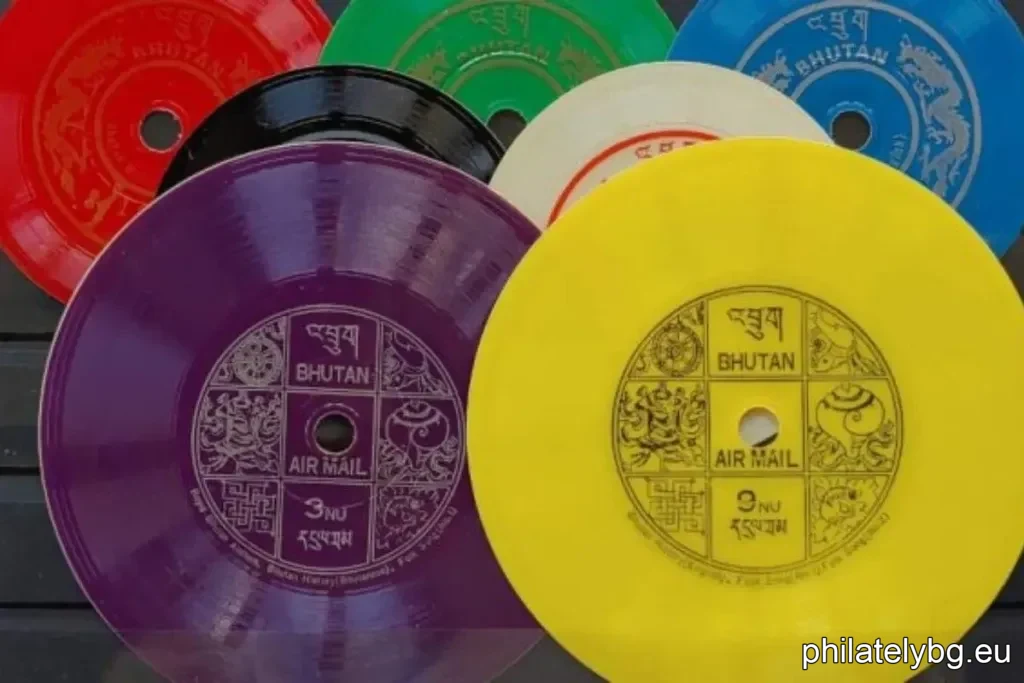
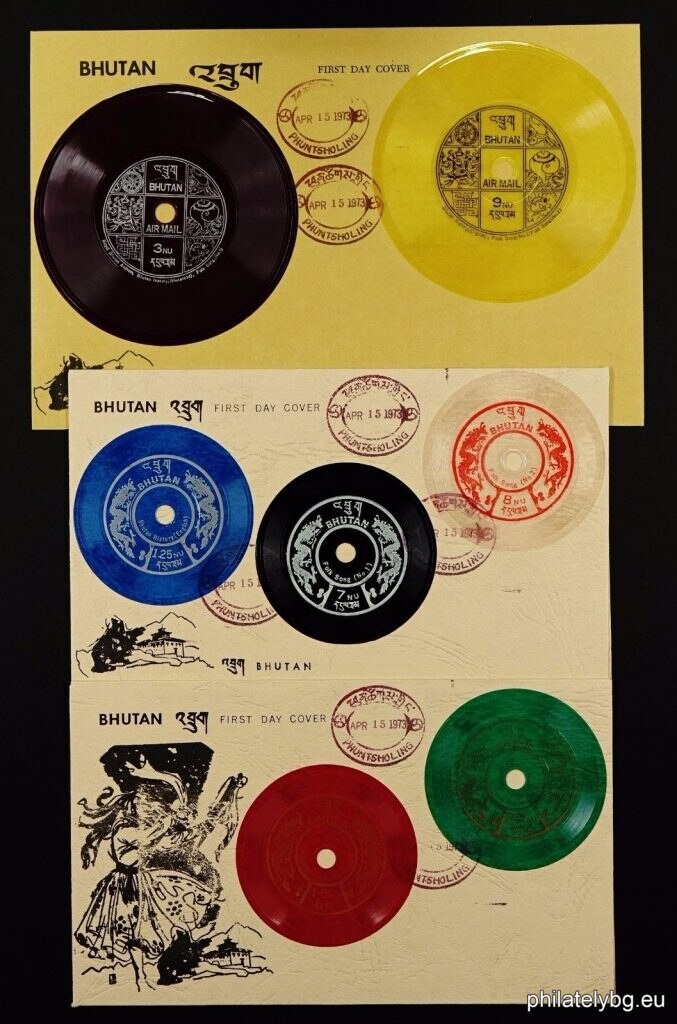
The result was a series of philatelic firsts. Round coin-shaped stamps made of foil appeared in 1966, three-dimensional stamps with a plastic overlay in 1967, and stamps printed on silk in 1969. They were joined by stamps of steel foil which, according to one account, rusted. The most famous became the "talking" stamps, miniature records that could be played on a turntable and contained folk songs, the national anthem and a short history of the country. The sources disagree on their year: some give 1972, others 1973. Todd's firm lost its contract in 1974, after which Bhutan moved to more conventional issues.
How did collectors of the time receive these stamps? The evidence is contradictory and shows how changeable such judgements are over time. The three-dimensional stamps were called gimmicks by philatelists but won the attention of casual collectors, and Todd even organised giveaways of Bhutanese stamps with purchases in American supermarkets. One publication claims that many collectors at first ignored them, while some of the early issues later became cult items. The Scott catalogue listed the talking stamps only in 1993, when a mint set was valued at about seventeen pounds. Later, interest in them was fuelled by the overlap of two kinds of collectors, philatelists and vinyl record enthusiasts. An asking price of 495 US dollars for a complete set on an online marketplace is only an illustration, not a market valuation.
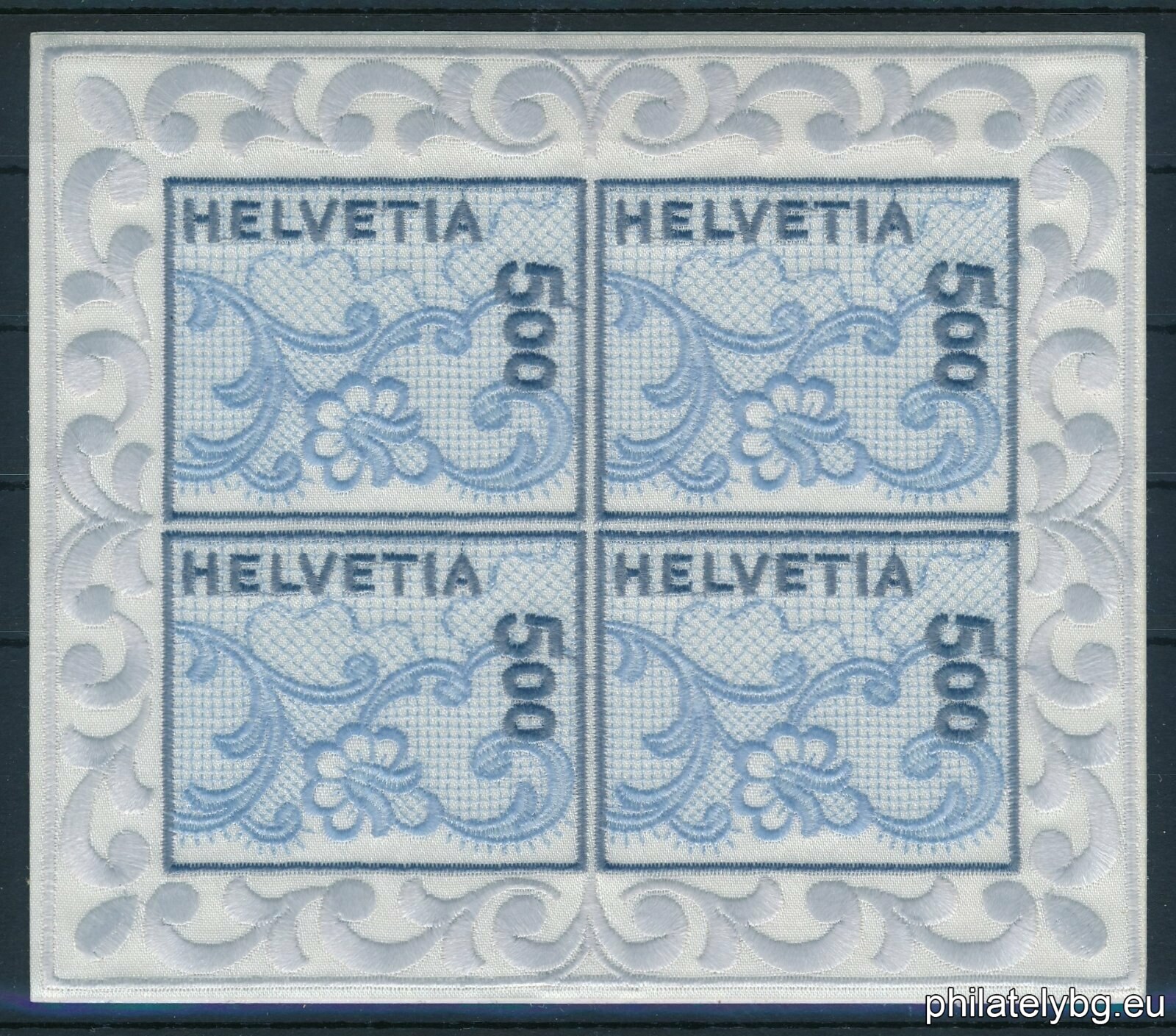
 The second wave is different in character, because it came from the postal administrations of developed countries themselves. On 21 June 2000 Swiss Post issued the world's first embroidered stamp, with a face value of 5 francs, presented at the national philatelic exhibition in St. Gallen. It was designed by Peter Hostettler, a textile designer at the firm Bischoff Textil, which also produced it. The embroidery uses polyester thread with a satin sheen and is genuinely three-dimensional, unlike printed stamps that merely depict embroidery. According to an auction description, only 20 examples a day were sold during the exhibition, which explains why the stamp was in demand. Embroidered stamps later appeared in other countries too: one dealer's website gives Italy for 2004 and Austria for 2005, which is worth checking against a catalogue. In 2025 similar issues appeared in several more countries, among them Luxembourg, produced by the Austrian firm Hämmerle & Vogel.
The next Swiss step was the wooden stamp. It was preceded by a 2001 issue imitating a bar of chocolate and containing scent capsules, and in 2003 came a stamp with Braille. The wooden stamp, with a face value of 5 francs, was the work of Thomas Rathgeb, a graphic designer employed by Swiss Post, and is about as thick as a credit card. The sources do not agree on several details. The sale date is 7 September 2004 according to catalogue and news publications, but one specialist website gives 7 November. The wood is described as pine, fir or spruce depending on the publication, and the age of the trees is given as 120 years. These discrepancies should be settled against Swiss Post's official announcement. The thickness itself raises a practical question of how such a stamp is kept in an album and how it passes through postal handling.
 After Switzerland the range of materials became even more varied. In 2008 Austria issued a stamp for the European football championship made of the synthetic material used for the surface of footballs, and another of its issues contains fragments of Swarovski crystal. The Faroe Islands experimented with tanned fish skin, and Hong Kong issued a sheetlet with 22-carat gold-plated metal lace, described as a world first. On 6 March 2025 Swiss Post issued a sheet with a large piece of gold foil for the 150th anniversary of the Federal Supreme Court. One essential rule applies here: according to a Universal Postal Union presentation, such a stamp must still be cancellable, that is, it must serve as a genuine postage stamp. Only this verifiable postal function separates it from a souvenir.
So how are these stamps received? Critics warn that more lasting value belongs to the stamps of administrations that treat the collector as a long-term customer and follow a restrained issuing policy rather than resorting to tricks. Defenders of the new materials point out that such stamps often sell out within days and attract not only regular collectors but casual ones too. The difference between a good and a dubious unusual stamp usually comes down to a few questions: is it issued by a genuine postal administration, does it really serve for postage, is the print run reasonably limited, and is the material connected with the meaning of the subject? Embroidery for St. Gallen and wood for the timber industry answer these questions better than foil coins sold by an agency in the Bahamas. One important caveat: the materials reviewed do not show that an unusual material by itself excludes a stamp from catalogues or exhibitions. The rules of the International Federation of Philately, as far as they are described, are aimed at illegal and abusive issues, not at the material.
Sources
Swissinfo, "Swiss Post introduces first embroidered stamp" (swissinfo.ch): news report on the 2000 embroidered stamp, its designer Peter Hostettler and the firm Bischoff Textil.
Art on Stamps, "The St. Gallen Embroidery" (artonstamps.org): amateur philatelic site giving the date 21 June 2000 and describing the polyester thread and the machine used.
Reinhard Fischer auction house, lots for the Swiss embroidered stamp (auktion.reinhardfischerauktionen.de): description of sales of 20 examples a day at the St. Gallen exhibition; a trade source.
Swissinfo, "Swiss Post branches out into wooden stamps"; Post & Parcel, "Swiss Post Office launches wooden stamp" (swissinfo.ch, postandparcel.info): news on the wooden stamp, its designer Thomas Rathgeb, its thickness and the sale date.
Art on Stamps, "The Swiss Wooden Stamp" (artonstamps.org): amateur site giving 7 November 2004 and spruce; differs from the news reports.
StampWorld, catalogue entries for Switzerland 2004 (stampworld.com): date 7 September, designer, format; an online catalogue with no official status.
Worksthatwork, "History of Bhutan postage stamps"; Mental Floss, "The Eccentric Entrepreneur Who Put Bhutan on the Map With Talking Postage Stamps"; Amusing Planet, "The Talking Stamps of Bhutan": popular accounts of Burt Kerr Todd, the Bhutan Stamp Agency, the materials of the stamps and philatelists' reaction to them.
The Vinyl Factory, "The curious tale of Bhutan's playable record postage stamps" (thevinylfactory.com, copy via cloud.tencent.com); NPR, "A Collector's Envy: Bhutan's Playable Postage Stamps" (npr.org): Scott listing in 1993, prices, collector interest; the year 1972 differs from 1973 in other publications.
Singapore Philatelic Museum / roots.gov.sg, "Stamps of Approval"; Universal Postal Union, presentation "Innovative Philately" (upu.int); AT Issue Journal (atissuejournal.com); a document hosted by the University of Malta (um.edu.mt, author and journal not established); Pwmo.org materials: Austria's football stamp, the gold and foil issues, fish skin, the requirement that a stamp be cancellable, opinions on gimmick issues and data on illegal and abusive issues.
Document on the "Top 2025 releases" (scholarhub.unimas.my): on Switzerland's 2025 gold foil stamp and the embroidered stamps of 2025; a secondary source, a collectors' ranking and not an official announcement.
Danstopicals.com: a dealer site giving embroidered stamps of Italy 2004 and Austria 2005; not confirmed against a catalogue.