Philately Bulgaria – New Generation is a modern platform created for collectors, researchers, and everyone who values postage stamps as cultural and historical heritage. The site combines a scientific approach, modern digital tools, and clearly structured information about Bulgarian and world philately, presented in an accessible and professional way.

📰 Latest News 18 November 2026

News | Mail That Reached the Moon: The Apollo 15 Postal Covers Scandal

ПревюIn 1971 the crew of Apollo 15 took hundreds of postal covers that were not on the approved list, and some of them reached collectors. The story of the scandal, the punishments, and the question of what may be carried into space.

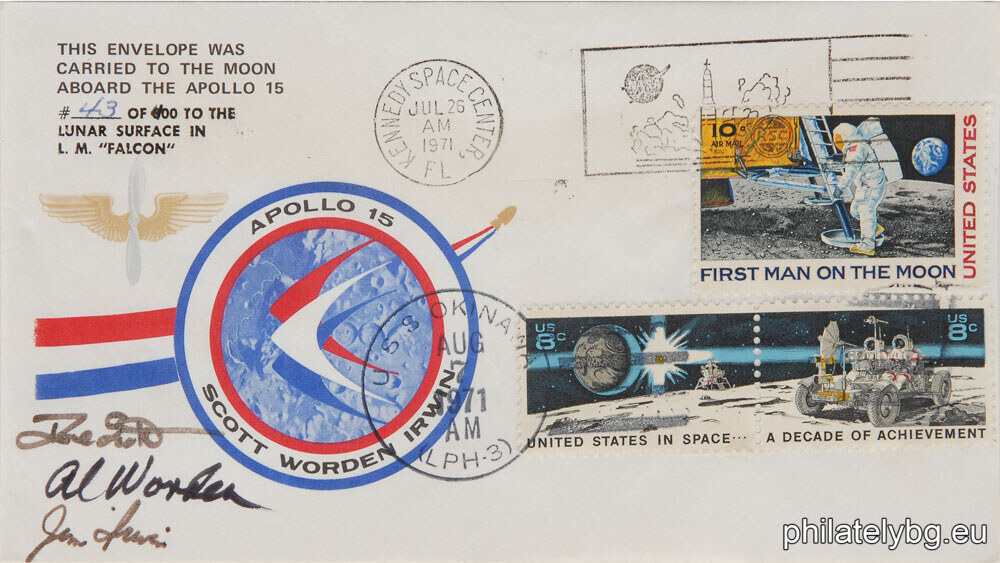
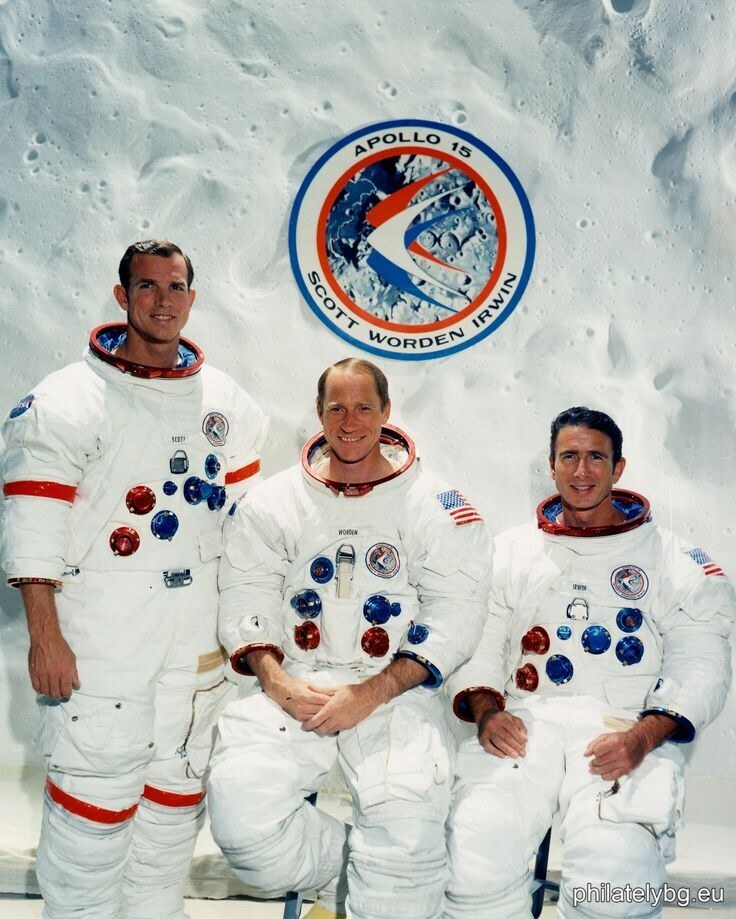
On 26 July 1971 Apollo 15 set off for the Moon with Commander David Scott, Command Module Pilot Alfred Worden and Lunar Module Pilot James Irwin. In a pocket of Scott’s spacesuit was a packet of about 400 thin postal covers, each with a stamp and postmark, which were not entered in the list of personal items approved before the flight. The covers reached the lunar surface in the lunar module Falcon and returned to Earth. In 1972 the story became a scandal that reached a closed session of the United States Senate. The newspapers of the time wrote that the astronauts had carried them secretly, but the facts about the sales are more complicated. One hundred of the covers were handed to an intermediary and were sold by the German stamp dealer Hermann Sieger. The remaining roughly 300 the astronauts kept for themselves and did not sell – NASA seized them. This publication therefore relies on the documents: NASA’s press release of 15 September 1972, the record of the closed Senate session of 3 August 1972, and contemporary newspapers. Where the sources disagree, or where there is only supposition, this is stated plainly.

The context is the time when space philately was at the height of its popularity. Collectors sought covers that had been carried in space or postmarked on launch day, and astronauts were used to taking part in the making of such souvenirs. Before each flight they drew up a list of personal items they would carry, and it was approved. For Apollo 15, NASA later acknowledged 243 covers as “authorized and listed”, among them two covers of the United States Postal Service, a 1928 cover autographed by Orville Wright, and 144 covers carried by Worden. Of these, 100 bore a moon-phase design and were prepared with the help of the philatelist F. Herrick, who advised Worden to keep the covers for their future value to collectors. Trading was a different matter. According to the Senate record, a letter from Deputy Administrator George Low to Senator Clinton Anderson reports that several astronauts had accepted money for signing sheets of stamps from Horst Walter Eiermann, who was also connected with the Apollo 15 covers. Those sheets were not carried into space, but NASA notified the Department of Justice.
ПревюThe scheme began with two men from outside NASA. According to NASA’s press release, Hermann E. Sieger of Lorch, Germany, a major European stamp dealer, met H. Walter Eiermann on a visit to Cape Kennedy in 1970 (according to Wikipedia, the two met by chance on a bus to the Apollo 12 launch in late 1969). Eiermann was a naturalized American who had worked in the Cape Kennedy area for years and knew many astronauts. In early 1971 Sieger concluded that covers carried to the Moon would have great commercial value. In the spring of 1971, during Apollo 15 training, Eiermann proposed to Scott, and then to Worden and Irwin, that they carry 100 special covers for him. The offer was about $7,000 for each of them, in the form of savings accounts. The astronauts agreed and decided to take about 300 more covers for personal use – NASA later counted 298. According to the astronauts themselves, the covers were not to be used commercially until the end of the Apollo programme. Wikipedia, which relies on later books and testimony, also notes a dispute about where the proposal was made. Scott writes that a dinner at Eiermann’s home was arranged by the head of the astronauts, Deke Slayton, while Worden mentions only an invitation from Scott. Before the Senate in 1972, Scott said that he had met Eiermann at a party.

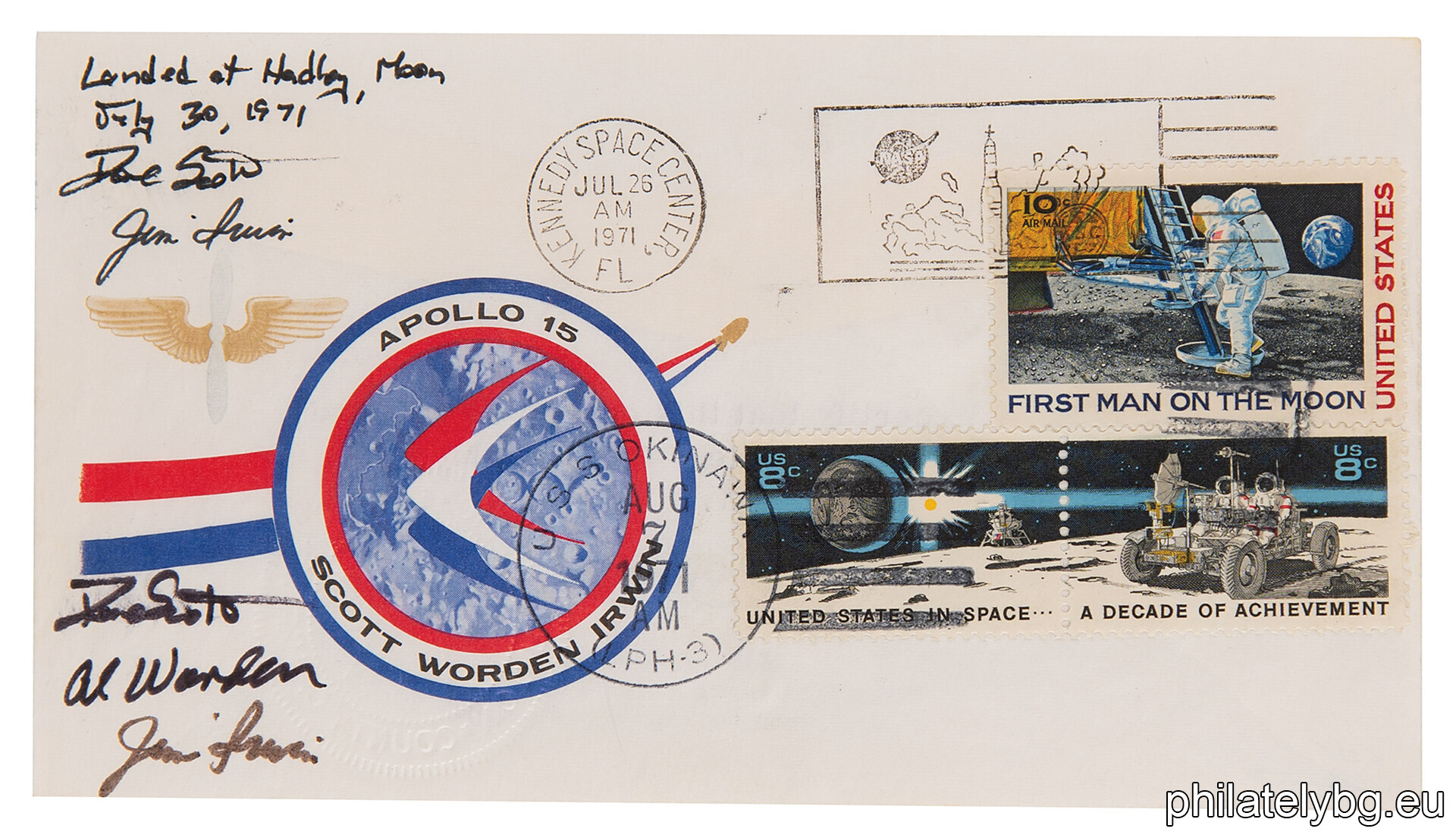
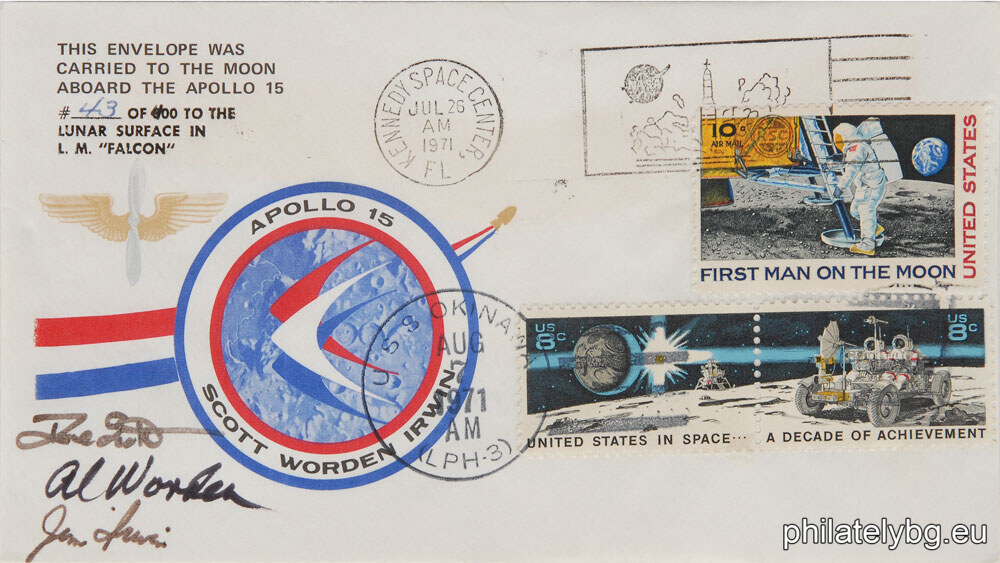
The covers were prepared on launch day. NASA reports that each cover bore a ten-cent “First Man on the Moon” stamp and was postmarked early on 26 July 1971 at the post office of the Kennedy Space Center. The covers were light, with a copy of the mission emblem and an overprinted Air Force symbol. They were not on Scott’s list of personal items. According to Wikipedia, the flight-support crew member James Smotherman later claimed that he had “goofed” and mixed up these 400 covers with Herrick’s approved covers – this is his claim, not an established fact. Scott carried the packet in a pocket of his spacesuit and, according to Wikipedia, the covers weighed about 850 grams. According to Wikipedia, Scott later admitted that this was a violation of the rules, but did not remember how the covers had reached the lunar module. Apollo 15 landed on the Moon on 30 July, and the covers stayed in Falcon until 2 August (per Wikipedia). The spacecraft splashed down in the Pacific on 7 August 1971. On board the recovery ship Okinawa the astronauts affixed two eight-cent stamps to each cover and the ship’s post office postmarked them. They then signed them during the flight from Hawaii to Houston.

Scott mailed the covers to Eiermann in Stuttgart on 2 September 1971, after on 31 August a notarized certificate had been typed on the back of 100 of them, stating that they had been in Falcon in the Hadley–Apennine region. Eiermann gave them to Sieger. By November 1971, 99 of them had been sold, at an average of $1,500 each. In a West German collectors’ magazine they were advertised at 4,850 German marks each. According to newspaper figures cited in the Senate record, the total was about $150,000. According to Wikipedia, Sieger signed and numbered each cover. Separately, NASA also examined Worden’s 144 approved covers: Herrick says that he personally sold three, sent several to Europe, and sold ten through a dealer on commission, receiving about $7,175. NASA found no evidence that Worden was to receive money from these sales.
ПревюThe discovery came gradually. In November 1971 the astronauts learned, on a trip to Europe, that the covers were being sold, and according to NASA, Scott telephoned Eiermann to stop the sales and return the covers. In February 1972 they refused the money. NASA reports that Eiermann had opened a $7,000 account for each of them in a German bank and Scott arranged for it to be returned. The proposal that they receive an album of stamps for their families instead was first accepted and then rejected in April 1972. The sources describe this part differently: NASA’s press release speaks of accounts that the astronauts refused, while some later sources write that they “returned” money they had received. According to Wikipedia, which draws on Slayton’s memoirs, on 5 November 1971 he warned Worden to stop trading in Herrick’s covers, and on 11 March 1972 a letter from Lester Winick to NASA’s general counsel raised questions about the Sieger covers. After speaking with Worden and Irwin, and in mid-April with Scott, Slayton removed the three from the Apollo 17 backup crew. According to Wikipedia he did not inform Fletcher, Low and Kraft; what he knew and when is disputed (see below).

The scandal became public in June 1972. According to Wikipedia, the story was first published in the Washington Sunday Star on 18 June, and on 29 June George Low ordered a full investigation. On 11 July 1972 NASA announced publicly that the astronauts had carried 400 unauthorized covers in addition to 232 authorized ones and that they had shown “poor judgment”. According to the Associated Press, these covers could have been sold to collectors for $600,000 or more. The agency’s position was quoted in the newspapers of the time as follows: the crew had shown poor judgment and the three would be reprimanded, and their actions would be taken into account in future assignments. A NASA spokesman quoted by UPI described the reprimand as “damaging” and said that he did not think the three would fly again. Irwin had already announced that he was retiring from 1 August to head a religious organization. Scott and Worden were at that moment not assigned to any mission. According to the same newspapers, NASA estimated that 300 unsold covers had been seized in Houston.

On 3 August 1972 the Senate Committee on Aeronautical and Space Sciences held a closed session in a Senate building. Senator Clinton Anderson presided. Senators Symington, Cannon, Curtis, Smith, Goldwater and Weicker were also present. The session lasted about five hours and the witnesses were not sworn. Those who spoke were Administrator James Fletcher, his deputy George Low, Deke Slayton, Christopher Kraft and the three astronauts. Anderson stated in conclusion that the testimony was “forthright and complete”, that the question of whether laws had been violated “is being examined”, and that the committee had reached no conclusions. According to Fletcher’s words as quoted by the press, there was “no doubt” that NASA’s rules on employee conduct had been violated. The record also notes the remarks of the Department of Justice, which took a “substantial interest” in the case and asked that Fletcher’s report of 27 July be available only to the committee.
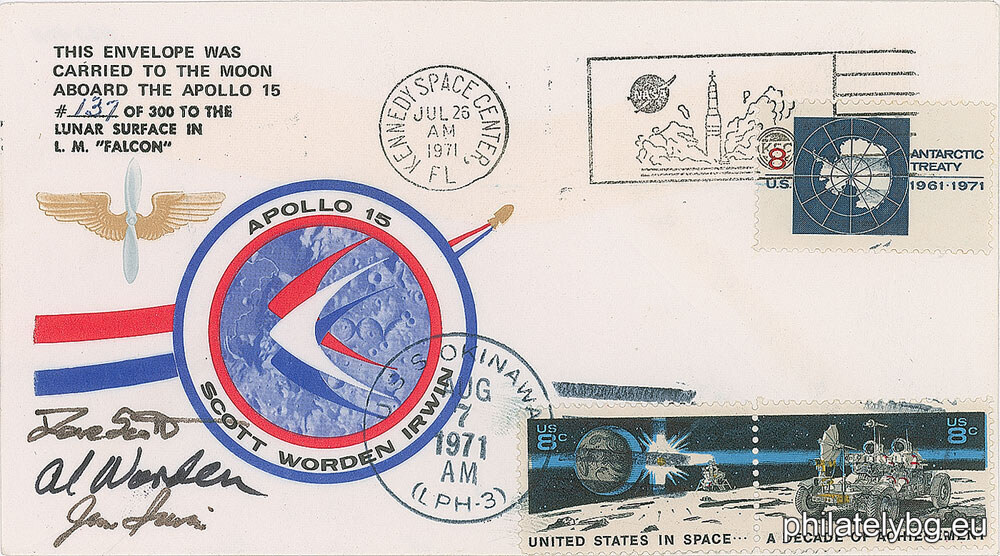
ПревюOn 15 September 1972 NASA published a detailed report (News Release 72-189). The figures were revised: 641 covers in all, of which 243 were authorized and 398 unauthorized (at first thought to be 400), of which 100 were handed to Eiermann and about 298 remained with the astronauts. The report found violations of regulations, irregularities and poor judgment by the crew, as well as weak communication in part of the management and inadequate administrative procedures. Scott, Worden and Irwin were formally reprimanded, and their military efficiency reports record a finding of lack of judgment – NASA wrote that this carries severe consequences for their careers. The Department of Justice reviewed whether criminal laws had been violated and whether to bring a civil action. The same report dealt with two other cases: the “Fallen Astronaut” sculpture, left on the Moon and later offered for sale in replicas, and two timepieces carried by Scott without permission, to evaluate them for a manufacturer.

The report also introduced new rules – they answer the question of what may be carried into space. Each astronaut may carry no more than 12 personal items, each weighing no more than half a pound, and all are approved by the Administrator. Items that could be exploited commercially by recipients are prohibited. The list of items carried is announced publicly no later than 30 days after the flight. Future flights also carry an official flight kit – flags, emblems, medallions – whose contents are approved and announced before the flight and whose commercial use is likewise prohibited. Today NASA’s rule 14 CFR §1214.602 applies: every memento must be approved and is stowed only in an official or personal kit, may not be sold, transferred for sale or used for personal gain, and philatelic materials and coins are not approved for flight, because by their nature they may be exploited by recipients or create problems with respect to good taste.

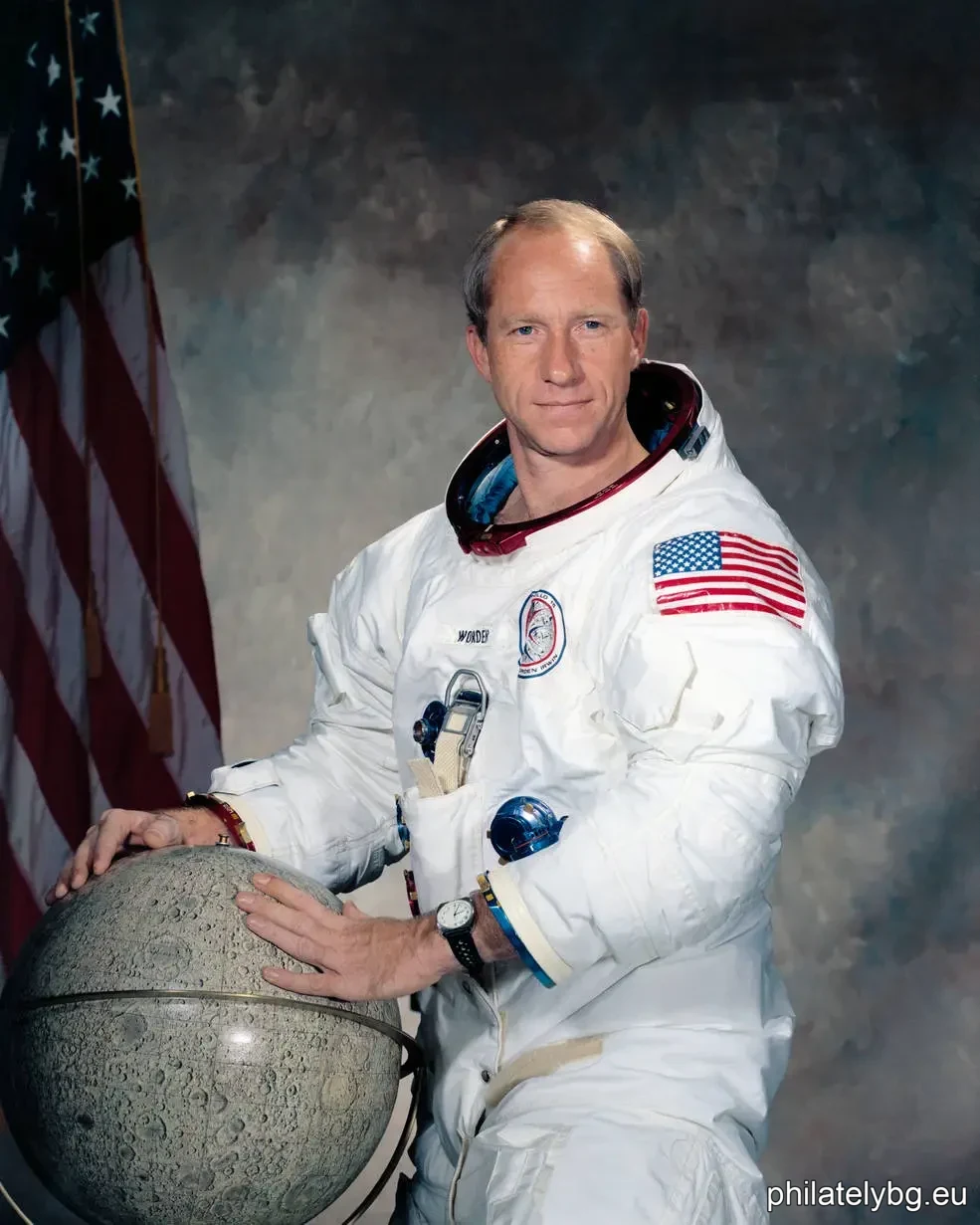
The consequences for the three were different. None of the crew flew in space again. Irwin left NASA in 1972. According to Wikipedia, Scott was technical adviser on the Apollo–Soyuz project, retired from the Air Force in 1975 and left NASA in October 1977, while Worden was transferred to the Ames Research Center and retired in 1975. The Department of Justice, according to the same source, declined to prosecute in 1974. In February 1983 Worden sued the government, claiming that the seizure of the covers without a hearing had violated the Constitution. According to postal and collectors’ sources, the astronauts cited the plan of NASA and the United States Postal Service to send about 260,000 covers aboard the space shuttle STS-8. The dispute was settled out of court and in July 1983 the covers were returned; Wikipedia reports 359 covers in all (298 covers of the crew and 61 of Worden). Notarized certificates dated 19 July 1983, signed by the three, accompany specimens sold later. A Sieger cover sold for over $50,000 in 2014, and a cover from Scott’s collection for $15,000 in 2008.
ПревюSome things remain unproven, and it is only honest to say so plainly. Whether Slayton knew of the plans before the flight is supposition. A Chicago Sun-Times journalist, cited by Wikipedia, considers it “ludicrous” that he did not know, but this is an opinion, not a document. According to Wikipedia, the government’s position in 1983 was that NASA either approved the covers or knew of them, but this too is disputed. Scott’s motive is also supposition – he says the money was for a trust fund for the children, but this is his explanation, given later. How the covers reached the lunar module is not known – the accounts of the three differ. It is also unclear whether Sieger knew that the sale was prohibited. The number of covers varies according to the document: 232 or 243 authorized, 398 or 400 unauthorized, 298 or 300 for the astronauts, 632 or 641 in all. The names of the intermediaries are also spelled differently: Hermann or Herman Sieger, Horst Walter or H. Walter Eiermann, and the Senate record also has the variant “Siermann”.

The story leaves a clear boundary: a personal item is allowed if it is approved, light, intended for personal or gift purposes and without commercial value. The scandal is not that a cover flew to the Moon, but that hundreds of such covers were brought along without approval and 100 of them became merchandise. Today the rule is strict. In 1983 the astronauts cited the shuttle covers as an argument for a double standard – this is their position, not an established fact.

People in this publication:
David Scott – commander of Apollo 15; carried the covers in a pocket of his spacesuit, received a reprimand, never flew again, and in 1983 got his covers back.
Alfred Worden – command module pilot; also carried the 144 authorized Herrick covers, received a reprimand, and in 1983 brought the suit for the return of the covers.
James Irwin – lunar module pilot; received a reprimand and left NASA in 1972 to devote himself to religious work.
Horst Walter Eiermann – naturalized American who worked in the Cape Kennedy area; proposed that the astronauts carry covers and passed one hundred of them to Sieger.
Hermann E. Sieger – stamp dealer from Lorch, Germany; sold one hundred covers to collectors at about $1,500 each.
Deke (Donald K.) Slayton – NASA’s director of flight crew operations; removed the three from the Apollo 17 backup crew.
James C. Fletcher – NASA Administrator, who published the report of 15 September 1972 and the new rules.
George M. Low – NASA Deputy Administrator, who ordered the investigation and reprimanded the crew.
Christopher C. Kraft – NASA official from the Houston center, present at the Senate session; according to Wikipedia he questioned Scott in June 1972.
Clinton P. Anderson – senator from New Mexico, chairman of the Senate committee that held the closed session.
F. Herrick – stamp collector from Miami who helped prepare Worden’s 144 authorized covers.
Lester Winick – author of the letter of 11 March 1972 to NASA’s general counsel that raised questions about the Sieger covers (per Wikipedia).
James Smotherman – member of the flight-support crew who later said he had mixed up the covers (per Wikipedia).

Sources:
NASA News Release 72-189, “Articles Carried on Manned Space Flights”, 15 September 1972 – http://www.collectspace.com/resources/flown_a15_articlescarried.html
U.S. Senate Committee on Aeronautical and Space Sciences, closed session, 3 August 1972, “Commercialization of Items Carried by Astronauts” – https://archive.org/details/hrg-1972-asp-0008_from_1_to_406
Chicago Tribune, 12 July 1972, “NASA Reprimands Apollo 15 Crewmen” – https://www.newspapers.com/newspage/377353052/
The Philadelphia Inquirer, July 1972 – https://www.newspapers.com/newspage/180371871/
Philadelphia Daily News (UPI), July 1972 – https://www.newspapers.com/newspage/184532504/
York Daily Record (AP), 12 July 1972 – https://www.newspapers.com/newspage/81290202/
TIME, 1972 – https://content.time.com/time/magazine/article/0,9171,906132,00.html
Wikipedia, “Apollo 15 postal covers incident” (secondary source, used for the chronology and additional details) – https://en.wikipedia.org/wiki/Apollo_15_postal_covers_incident
14 CFR §1214.602 – https://www.law.cornell.edu/cfr/text/14/1214.602
Sotheby’s, 2018, Apollo 15 Sieger cover (lot description) – https://www.sothebys.com/en/auctions/ecatalogue/2018/space-and-exploration-n09897/lot.250.html
Heritage Auctions, Apollo 15 Sieger cover with certification of 19 July 1983 – https://historical.ha.com/itm/space-exploration/cover/apollo-15-lunar-module-flown-crew-signed-sieger-cover-19-with-signed-and-notarized-certification/a/6244-50390.s

📰 Latest News 16 November 2026

News | British Guiana 1c magenta of 1856 – the stamp a boy sold for six shillings

ПревюHow twelve-year-old Vernon Vaughan found the rarest stamp in the world and, with no idea what he held, swapped it for pocket money.

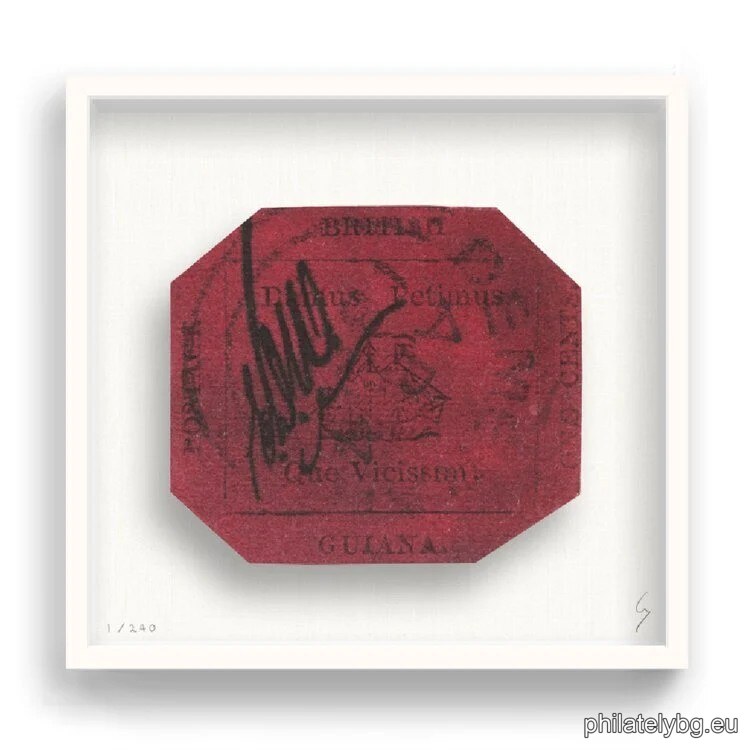
In 1856 a routine postal problem arose in British Guiana (today’s Guyana, in South America): a shipment of stamps expected from England was delayed. Postmaster E. T. E. Dalton commissioned the local printers of the Official Gazette in Georgetown to produce an emergency issue. The printers added a sailing-ship design of their own, and Dalton, unhappy with the result, introduced an anti-forgery measure: every stamp had to be initialled by a post office clerk.

One of the 1-cent stamps – meant for sending newspapers – bears the initials “E.D.W.” (of the clerk Edmond D. Wight) and is postmarked 4 April 1856. The letter that carried it was originally received by Andrew Hunter in Demerara. For the next seventeen years nobody paid any attention to the small scrap of paper.

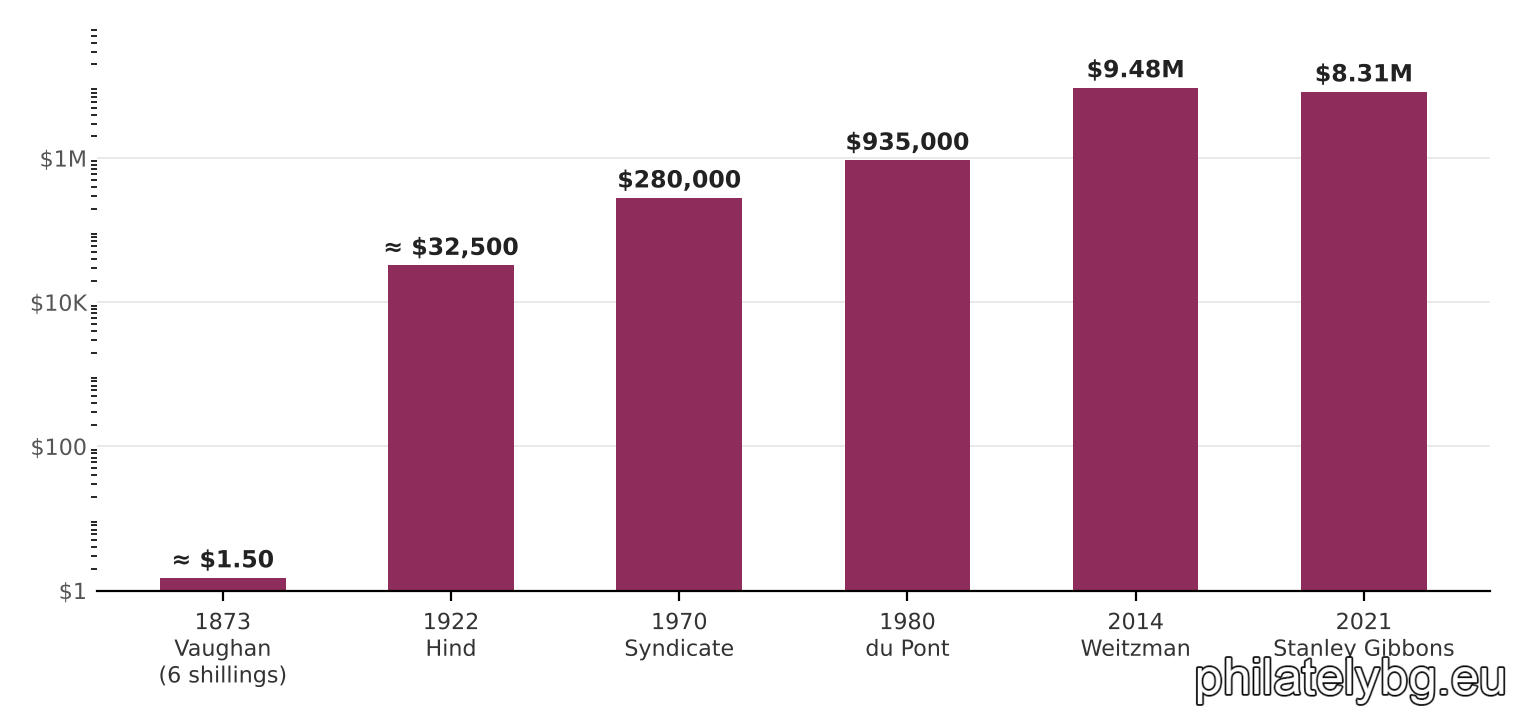
In 1873 Hunter’s nephew, Louis Vernon Vaughan, a twelve-year-old Scottish boy living in the colony, was going through his uncle’s family letters. He already collected stamps, but could not find this one in his catalogue. According to Stanley Gibbons, he soaked it off the envelope and briefly kept it in his collection, then a few weeks later sold it for six shillings to a local collector, Neil Ross McKinnon. According to Linn’s, that was about $1.50.

Why did he not realise what he was holding? The stamp was not listed in the catalogues of the time, its corners had been cut off so it was octagonal, and it was heavily smudged with postmarks. Today it is the only known example, and the Smithsonian’s National Postal Museum says no stamp is rarer.

In 1878 McKinnon’s collection was sold to the Liverpool dealer Thomas Ridpath for £120. He recognised the stamp’s rarity and soon resold it to the Austrian collector Philipp von Ferrary for about £150. After Ferrary’s death in 1917 his collection was seized by France as enemy property and auctioned in Paris in 1921–1926. On 6 April 1922 the collector Arthur Hind bought the stamp for 300,000 francs (352,500 francs with tax, about $32,500), then a world record.

The stamp then stayed with Hind’s wife, Ann Hind Scala, and in 1940 was sold through Macy’s in New York to the engineer Frederick Small for about $40,000. In 1970 an investment syndicate bought it for $280,000, and in 1980 John du Pont, heir to the chemical dynasty, paid $935,000.

ПревюNominal prices of the stamp over various years (logarithmic scale – each upward tick represents a price 100 times higher). The figures are in dollars and are not adjusted for inflation; the amount for 1873 is an estimate. Sources: Sotheby's, Wikipedia, Linn's, Stanley Gibbons.

John du Pont died in prison in 2010, where he was serving a sentence for the murder of Olympic wrestling champion Dave Schultz. On 17 June 2014 his estate sold the stamp at Sotheby’s in New York for $9,480,000 in about two minutes, a new world record for a stamp. The buyer was the shoe designer Stuart Weitzman.

An interesting detail for Bulgarian readers: under du Pont’s will, 80% of the proceeds were designated for the family of the former Bulgarian wrestler Valentin Jordanov Dimitrov, and 20% for a wildlife conservation foundation.

On 8 June 2021 Weitzman put the stamp up for auction at Sotheby’s again. This time it sold for $8,307,000 to the London firm Stanley Gibbons, below expectations. Since November 2021 the company has also offered shares in the stamp (80,000 shares at £100 each), so today anyone can own a small piece of it.

For young collectors Vaughan’s story is both a warning and an inspiration. A warning, because not every worn and dirty stamp is worthless – it is worth asking an experienced collector before selling. An inspiration, because the boy’s role is real: he was among the first to keep it as a collector’s find instead of throwing it away. The most valuable discovery in the history of philately was made not by a dealer or a museum, but by a child going through his uncle’s letters.

Note: sources differ on some details, for example the 1940 price ($40,000 or $45,000). The article uses the most commonly cited figures.

Sources: Wikipedia – British Guiana 1c magenta; Smithsonian National Postal Museum (6 Nov 2014); Stanley Gibbons – stanleygibbons.com/magenta; Collectors Club of Great Britain (1 Nov 2020); Linn’s / Coin World (25 Apr 2015); Washington Times, Al Jazeera, Cyprus Mail (8 Jun 2021 auction); The Daily Beast, Philadelphia Magazine, David Feldman (du Pont’s will, 2014); Newswire, ABPS.

📰 Latest News 09 November 2026

News | “Fauna 2026” – New Stamp Issue from Bosnia and Herzegovina Features Endangered Wild Cats

ПревюAnother interesting postal issue arrives from Bosnia and Herzegovina – FBiH. On 1 November 2026, Croatian Post Mostar put into circulation a series of four commemorative postage stamps titled “Fauna 2026”, dedicated to four endangered wild cat species: the tiger (Panthera tigris), the cheetah (Acinonyx jubatus), the leopard (Panthera pardus) and the jaguar (Panthera onca). The illustrations were created by Zoran Vlašić, and the stamps were printed by AKD d.o.o. Zagreb.

Each stamp depicts its subject in an imagined natural habitat, rendered in watercolor technique with close attention to the detail of the fur and the distinctive markings of each species. The tiger, the largest cat species in the world, lives in the jungles of Asia and on the islands of Sumatra and Java – its coat is reddish-yellow with transverse black stripes, and the female gives birth to one to seven cubs every 3 to 4 years. The cheetah, today found almost exclusively in Africa, is the fastest land mammal – its grayish-yellow fur is covered with black spots, and black rings are visible on the rear third of its tail.

The leopard is a slender and agile predator found in Africa and Asia, with a yellowish to reddish-brown coloring interspersed with irregular dark ring-like spots. The female usually gives birth to two to three cubs, which are born blind and completely helpless, but grow quickly and already at the age of two to three months begin to eat meat. The jaguar, meanwhile, is the largest wild cat on the American continent, found from South America all the way to Patagonia – its yellowish-brown fur is covered with dark irregular spots and rings, and the female gives birth to one to four cubs. The texts accompanying the issue were written by Željka Šaravanja.

The stamps have a face value of 1.20 BAM each, measure 35.50 x 25.56 mm, and are printed on white gummed paper weighing 102 g with comb perforation 14. The issue was printed in sheets of 8 stamps, with a print run of 10,000 series. A special postmark and a first day cover (FDC) were also issued alongside it, which, together with the other philatelic materials, add to the collectible value of the issue.

The stamps, first day covers and other accompanying materials can be purchased at HP Mostar post offices, as well as online at www.epostshop.ba. The “Fauna 2026” issue continues the long-standing tradition of postal administrations drawing attention, through philately, to the topic of protecting endangered species and the world’s biological diversity.

Home
🔖 Latest Stamps 18 August 2026

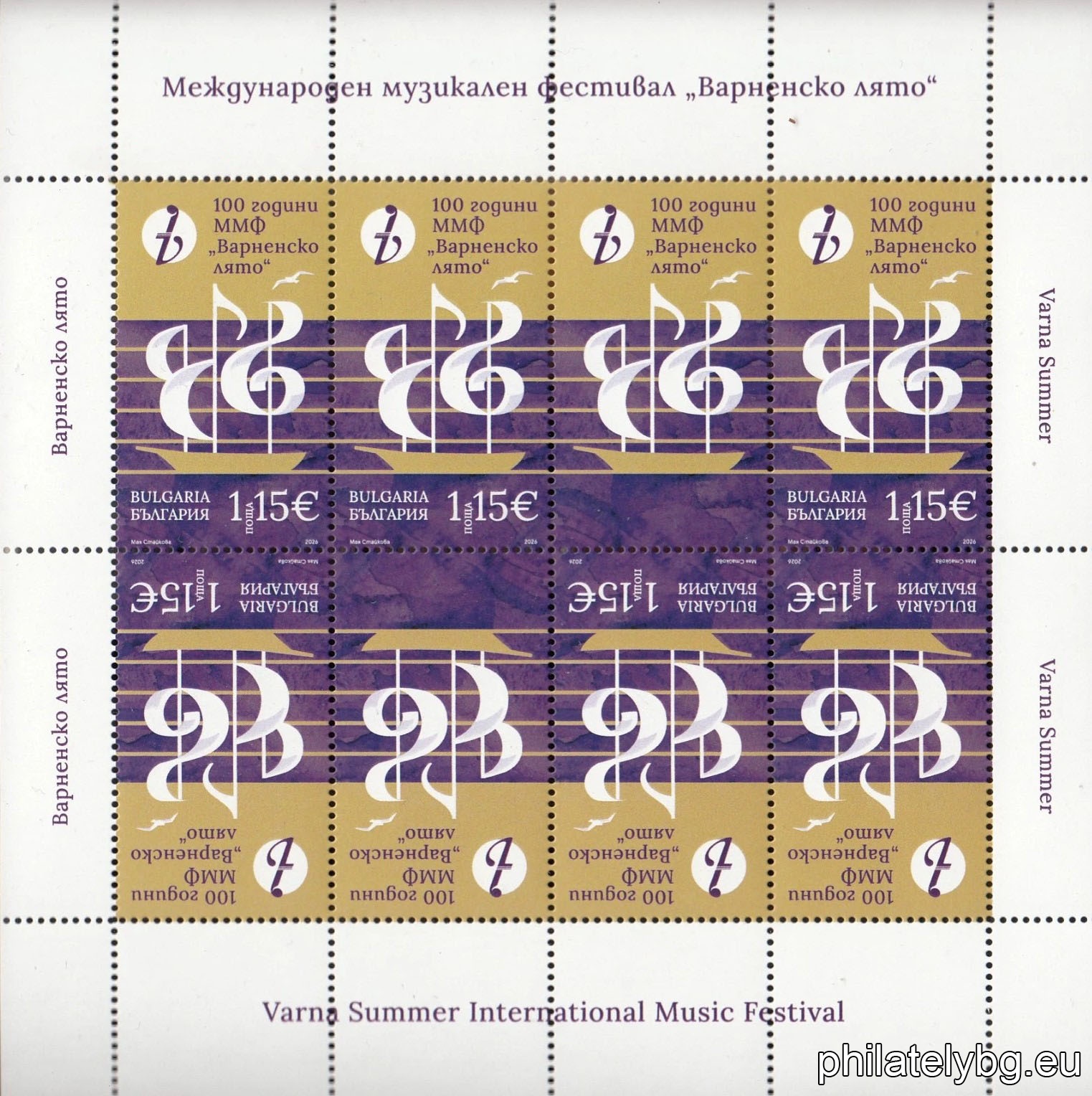
"100 years since the establishment of the International Music Festival "Varna Summer"" - a block sheet containing six postage stamps and two vignettes and a special postmark.

The Varna Summer International Music Festival is the oldest music festival in Bulgaria, founded in 1926 in Varna. It brings together world-renowned performers, symphony and chamber orchestras, offering a rich program of classical music, opera, ballet and accompanying academies in the seaside capital.

🔖 Latest Stamps 18 August 2026

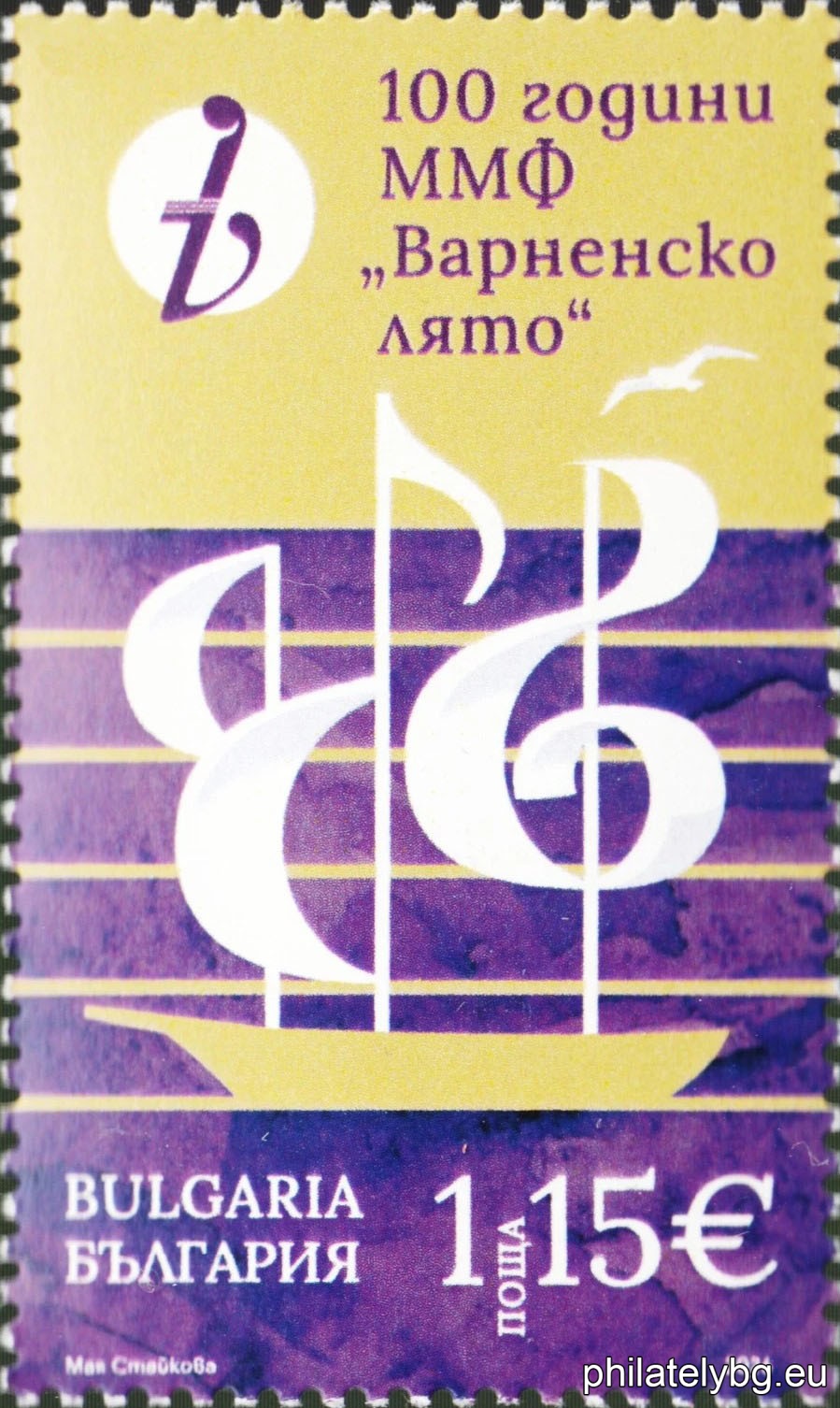
"100 years since the establishment of the International Music Festival "Varna Summer"" - one postage stamp and a special postmark.

The Varna Summer International Music Festival is the oldest music festival in Bulgaria, founded in 1926 in Varna. It brings together world-renowned performers, symphony and chamber orchestras, offering a rich program of classical music, opera, ballet and accompanying academies in the seaside capital.

🔖 Latest Stamps 10 August 2026

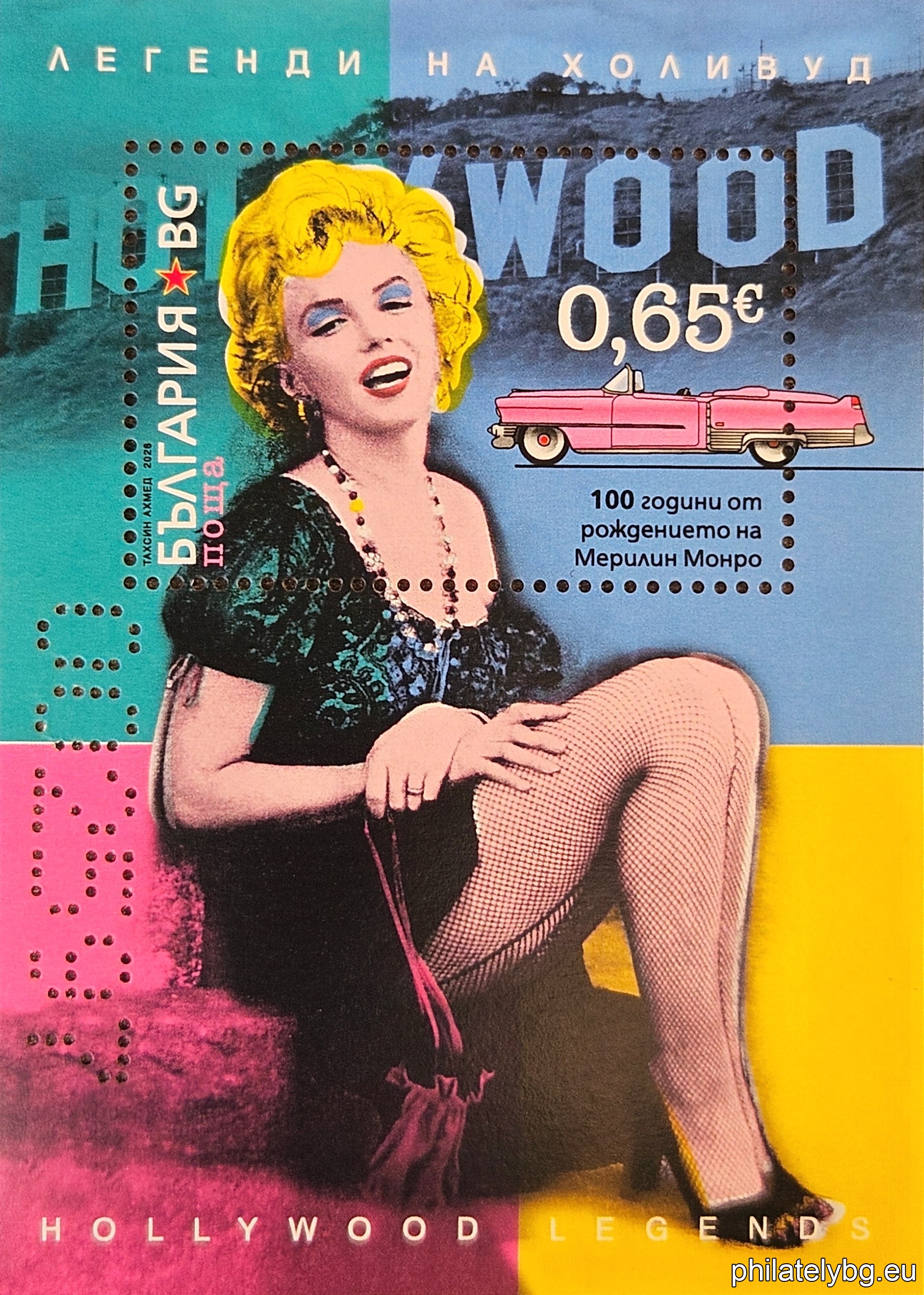
"100th Anniversary of the Birth of Marilyn Monroe." - one postage stamp in a block.

Marilyn Monroe, born Norma Jeane Mortonson, was an American actress and model. Her appearance made her one of the most popular sex symbols of the 1950s.

🔖 Latest Stamps 10 August 2026

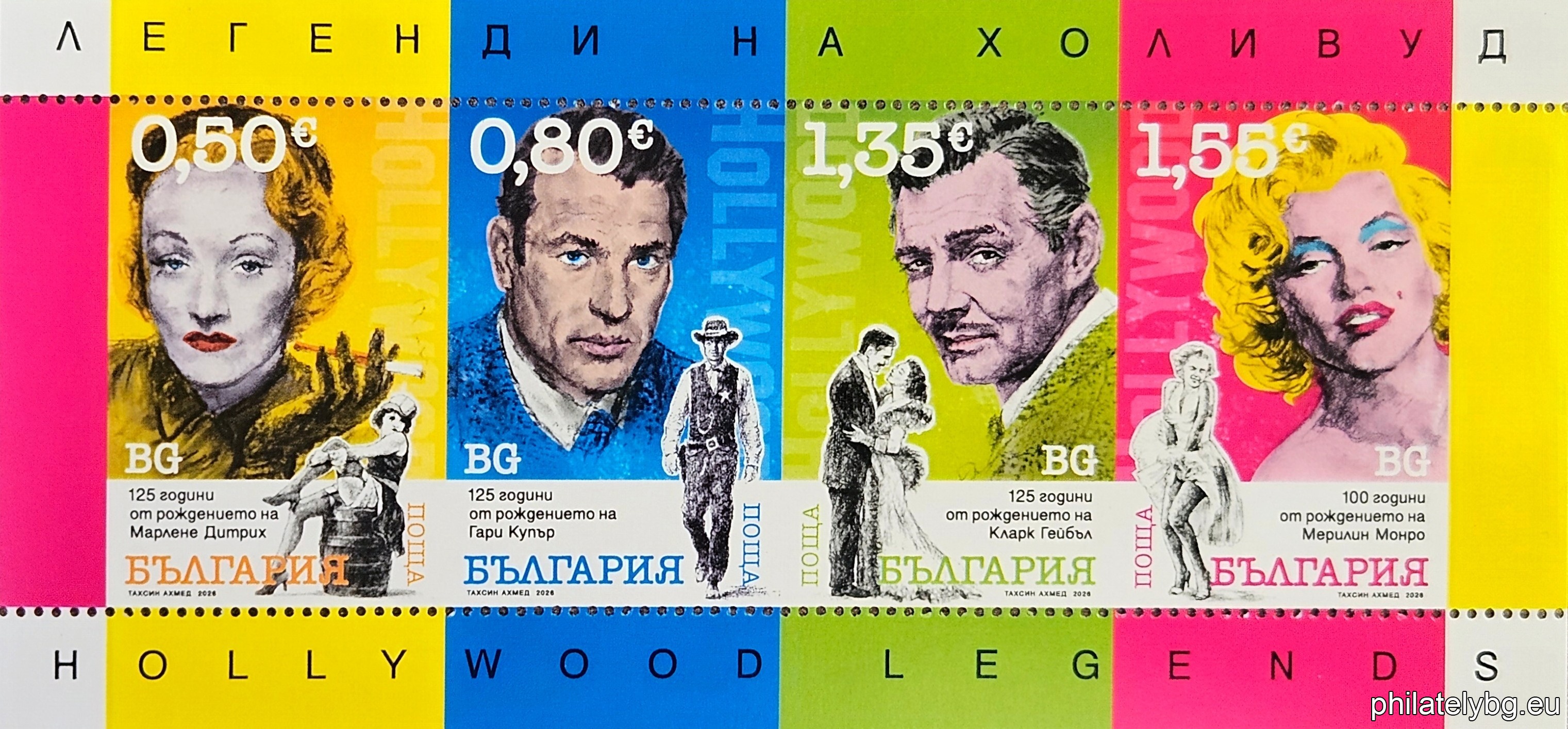
"Hollywood Legends: 125th Anniversary of Marlene Dietrichs Birth, 125th Anniversary of Clark Gables Birth, 125th Anniversary of Gary Coopers Birth and 100th Anniversary of Marilyn Monroes Birth." - a series of four postage stamps in a block sheet and a special postage stamp.

Marlene Dietrich is a German-American actress and singer. Clark Gable is an American actor, Oscar-winning, who played one of the most significant roles in cinema, that of Rhett Butler in the film Gone with the Wind (1939). Gary Cooper, born Frank James "Gary" Cooper, is an American actor. Marilyn Monroe, born Norma Jeane Mortenson, is an American actress and model.

🔖 Latest Stamps 10 August 2026

"Hollywood Legends: 125th Anniversary of Marlene Dietrichs Birth, 125th Anniversary of Clark Gables Birth, 125th Anniversary of Gary Coopers Birth and 100th Anniversary of Marilyn Monroes Birth." - a series of four postage stamps and a special postmark.

Marlene Dietrich is a German-American actress and singer. Clark Gable is an American actor, Oscar-winning, who played one of the most significant roles in cinema, that of Rhett Butler in the film Gone with the Wind (1939). Gary Cooper, born Frank James "Gary" Cooper, is an American actor. Marilyn Monroe, born Norma Jeane Mortenson, is an American actress and model.

🔖 Latest Stamps 11 June 2026

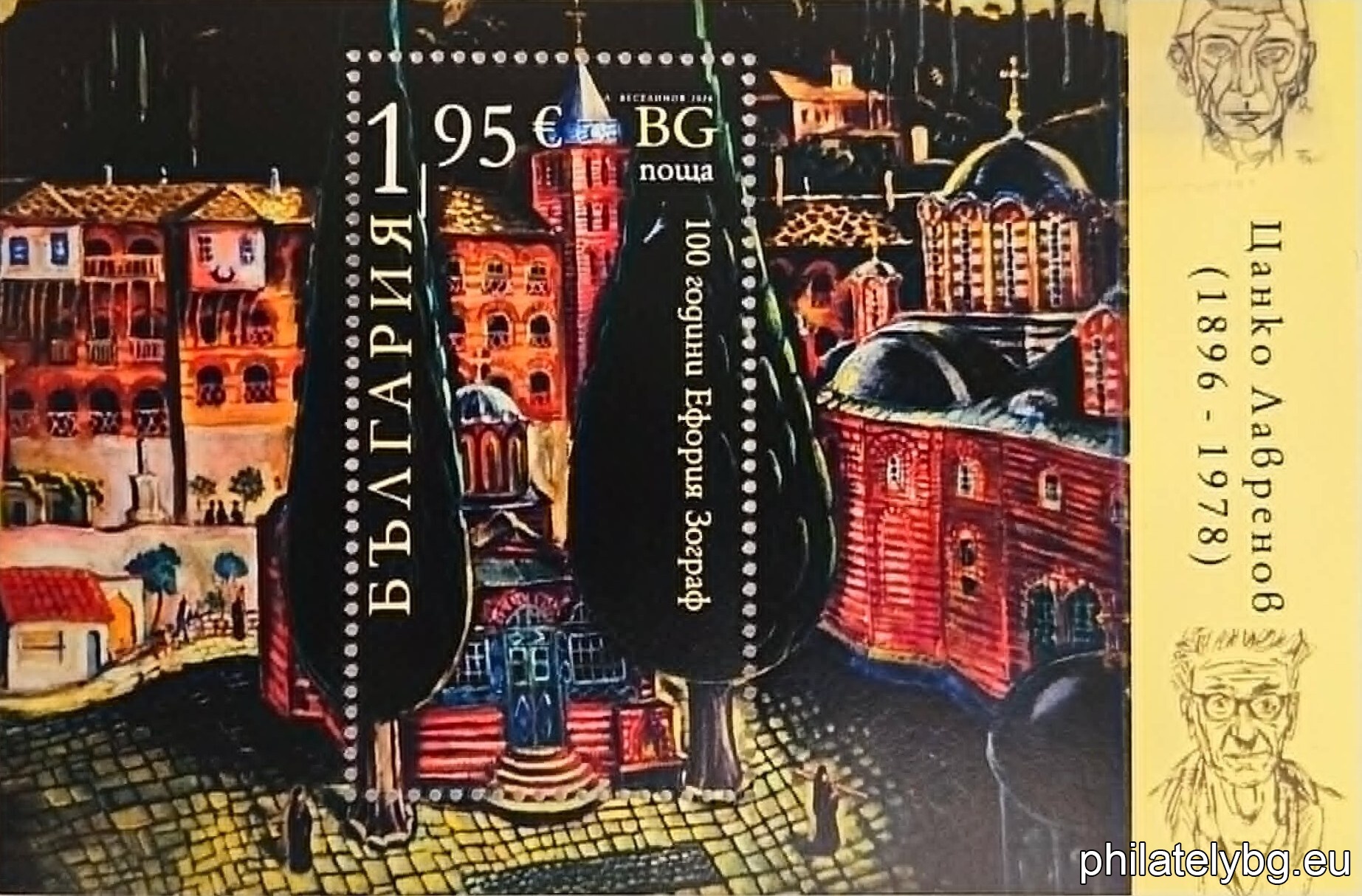
"100 years since the founding of "Eforia Zograf"" - one postage stamp in a block and a special postage stamp.

The anniversary marked an important historical moment: a hundred years ago, by decree of Tsar Boris, the "Ephoria Zograf" was established with the task of managing the Bulgarian monastery on Mount Athos.

🔖 Latest Stamps 02 June 2026

"Bulgarian Graphemes" – a series of two postage stamps with variable circulation.

The grapheme is the minimum structural unit of the writing system. In the modern Bulgarian language, the main graphemes are the letters that represent sounds (phonemes). The Bulgarian alphabet consists of 30 graphemes (letters), built on the Cyrillic writing tradition.

🔖 Latest Stamps 02 June 2026

"In memory of Hristo Botev - 150 years since his death" - one postage stamp and a special postmark.

Hristo Botev (Hristo Botev Petkov) was a Bulgarian revolutionary, poet and publicist from the era of the Bulgarian Renaissance. A national hero of Bulgaria.

🔖 Latest Stamps 29 May 2026

"Higher School of Telecommunications and Post" - one postage stamp and a special postmark.

The Higher School of Telecommunications and Posts is the successor of the State Telegraph and Postal School, founded by decree of Prince Alexander I on December 21, 1881.

🔖 Latest Stamps 22 May 2026

"125 years since the creation of the Anthem of Education by the composer Panayot Pipkov" - one postage stamp with one vignette and a special postmark.

The anthem of Bulgarian enlightenment, also known as the anthem of St. Cyril and Methodius, is the song "Go, Reborn People" with lyrics by Stoyan Mihaylovski and music by Panayot Pipkov.

All Stamps ›
🎬 Latest Videos

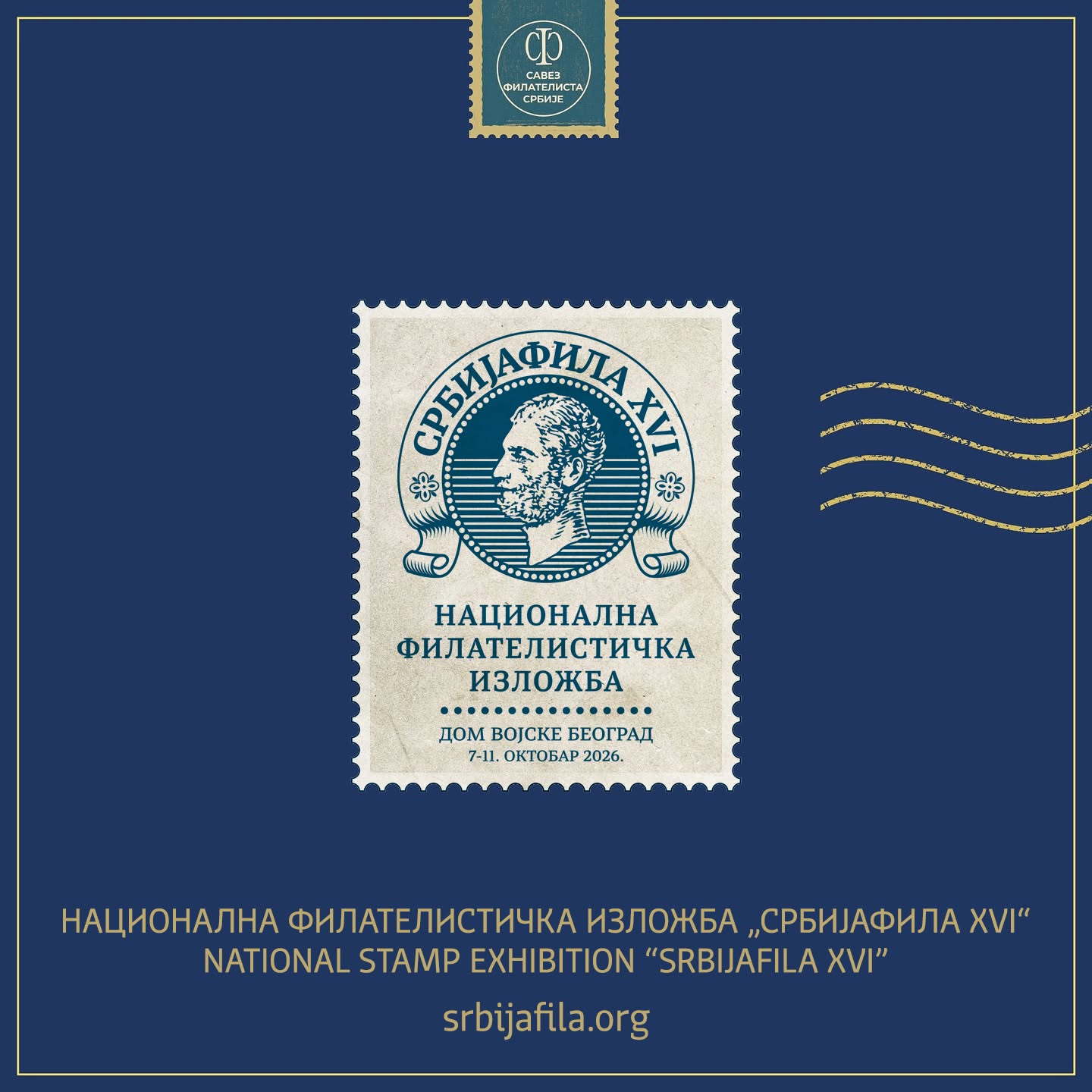
SRBIJAFILA XVI video

📅 Latest Events 05.11.2026

Events | TimFilEx 2027 – National Philatelic Exhibition with International Participation, Timișoara, Romania

ПревюThe Philatelic Association of Timișoara, Romania, together with the West University of Timișoara, is organizing TimFilEx 2027 – the traditional national exhibition, dedicated this year to the 150th anniversary of the War of Independence and to the work of the Banat painter Silviu Oravitzan. The exhibition will take place from November 19 to 21, 2027, at the West University of Timișoara, with approximately 400 exhibition frames available to participants.


TimFilEx has a long-standing tradition in the city, which has always been among the leading centers of philatelic life in Romania – as early as 1923, Timișoara hosted the country’s first national philatelic exhibition. Since 2021, the exhibition has been organized almost yearly under the TimFilEx name, with each edition dedicated to a different theme tied to the life of the city: the industrial history of Timișoara (2021), the centennial anniversary of the first dog show in Romania (2022), Timișoara’s status as European Capital of Culture (2023), and the personality of Queen Maria (2025).

The main classes include traditional philately, postal history, postal stationery, aerophilately, astrophilately, thematic philately (with subclasses Nature, Culture/History and Technology), revenue philately, modern philately (from 1980 to today), open class, experimental class, maximaphily, picture postcards, and philatelic literature. In addition, there will be a Court of Honor, invited exhibits, and a special non-competitive “Class without Class” for children and beginner philatelists, which follows no fixed rules, is not judged, and awards every participant a diploma.

The exhibition also includes a youth class (Class 13), divided into age groups – A (10–15 years), B (16–18 years), and C (19–21 years) – with participation completely free of charge. A digital component is also included: within the philatelic literature class there is a dedicated subclass for digital literature, websites, and software, treated as an experimental class, while the other literature subclasses may be submitted in either printed or digital form.

Regarding deadlines, entry application forms must be submitted by July 1, 2027, notifications of acceptance or rejection along with the number of allotted frames will be sent by September 1, 2027, and accepted exhibits must arrive at the Organizing Committee no later than November 10, 2027. The participation fee is 10 EUR per frame for most classes, the youth class is free of charge, and the literature class fee is 25 EUR per exhibit. A philatelic fair will additionally be held on November 20, 2027. The organizers invite stamp collectors from Romania, the Balkans, and all of Europe to join TimFilEx 2027.

📅 Latest Events 05.09.2026

Events | IBRA 2028 – World Stamp Exhibition in Ulm, Germany

ПревюFrom 26 to 29 October 2028, the German city of Ulm will host the IBRA 2028 World Stamp Exhibition. It will take place at the Messe Ulm exhibition centre and will have some 2,000 frames at its disposal. The organizer is the German Federation of Philatelists (Bund Deutscher Philatelisten) in collaboration with the Federation of South-West German Philatelic Societies (LSW), with the event managed and run by an organizing committee. The stated aims are the classic ones for an event of this kind – strengthening friendly relations and close cooperation among philatelists worldwide, and promoting philately and stamp collecting at the highest international level.


IBRA 2028 holds the status of a general World Stamp Championship Exhibition under the patronage of the Fédération Internationale de Philatélie (FIP), which is to be officially granted by the 78th FIP Congress in Macao in 2026. The exhibition is also held under the patronage of the Federation of European Philatelic Associations (FEPA). The general regulations GREX and GREV apply, together with the special regulations for the evaluation of exhibits (SREVs) and these individual regulations (IREX). Exhibitors from FIP member federations are eligible to take part in the competitive classes, while entry to the non-competitive classes, including the Court of Honour, is by special invitation from the organizing committee.

The competitive programme comprises fifteen classes. Class 1 is the FIP Championship Class, where the standard requirements apply – three Large Gold medals at FIP world exhibitions in three separate years, with no more than one Large Gold credited per year, and eligibility beginning on 1 January of the year following receipt of the third. Once qualified, an exhibit may compete in the Championship Class in any five calendar years of the exhibitor's choosing within a ten-year span. The list of qualified exhibits is published at the end of each year by the FIP Board.

Traditional Philately and Postal History follow, each with a national sub-class for Germany and sub-classes for Europe, America, and Asia, Oceania and Africa. Separate classes are provided for Postal Stationery, Aerophilately, Astrophilately, Thematic Philately with sub-classes for nature, culture and technology, Open Philately, Revenues, Picture Postcards and Maximaphily. Class 12 is the experimental "1–3 Frames" class: one-frame exhibits must treat a narrowly defined subject, and extracts from previously shown five- to eight-frame exhibits are expressly not permitted, while two- and three-frame exhibits are allocated to sub-classes for Traditional Philately, Postal History, Postal Stationery, Aerophilately, Thematic Philately and Revenues. Evaluation in Class 12 is on a scale of 60 to 100 points, and awards are given by certificate only, without medal levels; exhibits below 60 points receive a certificate of participation.

Class 14 – Youth Philately – deserves particular attention, and at IBRA 2028 it is entirely free of charge. Age is determined as of 1 January 2028, and participants are divided into three groups: group A from 10 to 15 years, group B from 16 to 18 years and group C from 19 to 21 years. The size of the exhibits grows with age – one to three frames for the youngest, two to four for the middle group and three to five for the oldest. It is worth noting that, unlike at some other exhibitions, the lower age limit here is expressly set at 10 years, meaning the youth class is not open to children below that age. The absence of a participation fee remains the strongest incentive for young collectors to step onto the world stage, and it deserves active support from national federations and from the mentors of young exhibitors.

An equally important point is Class 13 – Philatelic Literature – which at IBRA 2028 is formulated in very contemporary terms. Sub-class A covers philatelic books, monographs, non-periodical general and specialized catalogues, articles, handbooks and specialized research studies published after 1 January 2023. Sub-class B is for philatelic magazines and periodicals presented as at least one complete annual volume published after 1 January 2025. Sub-class C is devoted entirely to digital media – digital literature, websites and software. Significantly, literature may be submitted in either printed or digital form, and for digital titles the exhibitor provides access credentials instead of a physical copy. One copy of each exhibit is required, and return is possible only if expressly requested on the application form and at the exhibitor's expense. Literature exhibits will be presented in a supervised reading area where visitors can consult them on site. In addition to the application, a separate Philatelic Literature Information Form must be completed, and the deadline for receipt of the exhibits is 1 July 2028.

A genuine novelty is Class 15 – Modern Philately, covering material from 1980 to the present. Its purpose is twofold: to encourage collectors of modern material to exhibit at the highest level, and to demonstrate to postal administrations that interest in recent issues remains alive. Eligible exhibits are those meeting the FIP regulations for Traditional Philately, Postal History or Postal Stationery and composed exclusively of material issued by postal administrations since 1980. Evaluation follows the respective SREVs, with express acknowledgement that modern material is often difficult to obtain and process and that its rarity and significance are harder to assess given the short elapsed period. Full FIP medals are awarded in this class, results are recorded in the official listings, and exhibits scoring below 60 points receive a certificate of participation. Acceptance is based on the recommendation of the national commissioner and at the discretion of the organizing committee, and the same exhibitor may also enter other classes, though with different exhibits.

The technical requirements follow the established standard. The frame measures 97 by 120 cm and holds 16 album pages in four rows of four, with a page size of 23 by 29.7 cm including the protective mount. The other formats recommended by the FIP are also accepted – 46 by 29 cm with eight sheets and 31 by 29 cm with twelve sheets. Exhibits must be mounted on white or light-coloured sheets; dark and black sheets are not accepted. Original expert certificates must be made available to the jury, either affixed to the reverse of the relevant sheet or submitted in a folder through the national commissioner, and a small © symbol or the letter "c" is placed in the lower right-hand corner of the sheet. With the exception of classes 12, 13 and 14, each exhibit is shown in five or eight frames: five frames for exhibits awarded at least a Vermeil at national level, and eight frames for those awarded at least a Large Vermeil at a previous FIP exhibition.

The fees are relatively moderate. For the competitive classes other than 12, 13 and 14, the fee is €100 per frame. The experimental "1–3 Frames" class costs €130 per frame. Philatelic literature is charged at €40 per exhibit, and where the same exhibitor submits several entries, each subsequent exhibit costs €30. Youth Philately and the non-competitive classes are free of charge. Once paid, fees are non-refundable.

The application procedure is a considerable convenience. Entries are submitted by the exhibitor or by the national commissioner through the website https://ibra2028.de, with a deadline of 29 February 2028. A copy of the introductory page in one of the official FIP languages must be attached, along with the additional information form in the case of literature exhibits; a synopsis is optional. Notification of acceptance or rejection, together with the number of frames allocated, will be sent through the national commissioners by 30 April 2028; fees are collected and forwarded by 15 May 2028; and changes to the title or synopsis are permitted until 31 May 2028. If the title differs from that used previously, the former title must be stated, along with the FIP exhibit ID number, which is obtained through the exhibitor's national federation.

All exhibits are delivered through the respective national commissioners; personal delivery by the exhibitor is not permitted, except for German participants. Shipment by air cargo is prohibited. The organizing committee will implement simplified customs procedures, with details communicated through the national commissioners at least three months before the exhibition. Insurance is the exhibitor's own responsibility and expense, and the committee accepts no liability for loss or damage during transit, storage or display. After mounting, the national commissioner must verify that all pages and philatelic items are intact and sign a confirmation form before the opening day.

The organizing committee is based at the BDPh headquarters at Am Hofgarten 4, 53113 Bonn, and the Commissioner General of the exhibition is Frank Blechschmidt. Peter Suhadolc is named as the FIP consultant, although the official appointment is still pending. In the event of a dispute, the German version of the regulations is authoritative and the legal venue is Bonn. Current information is published at http://www.ibra2028.de. Bulgarian philatelists considering participation would do well to contact the Union of Bulgarian Philatelists and the national commissioner well before February 2028 – particularly if they are interested in the youth class, in digital media, or in the new class for modern philately.

📅 Latest Events 05.09.2026

Events | PRAGA 2028 – Specialized World Stamp Exhibition

ПревюFrom 22 to 26 March 2028, Prague will once again host a world stamp exhibition. PRAGA 2028 will take place in the Průmyslový palác at the Výstaviště exhibition grounds in the Bubeneč district and will present approximately 2,500 exhibition frames. The organizer is the Union of Czech Philatelists, acting through the association "PRAGA 2028 – Světová výstava poštovních známek", which was established specifically for this purpose. The exhibition marks several anniversaries at once: 500 years since the establishment of a regular postal service between Prague and Vienna, 110 years since the founding of Czechoslovakia and the first Czechoslovak stamps, 35 years since the creation of the Czech Republic, and the tradition of world stamp exhibitions in Prague itself.
PRAGA 2028 holds the status of a Specialized World Stamp Championship Exhibition under the patronage of the Fédération Internationale de Philatélie (FIP). Patronage was provisionally granted by the FIP President and Board during the 168th and 169th FIP Conference meetings and finally approved by the 78th FIP Congress on 1 July 2026. The exhibition is also held under the recognition of the Federation of European Philatelic Associations (FEPA). The general regulations GREX and GREV apply, together with the special regulations for the evaluation of exhibits (SREVs) and the exhibition's own individual regulations (IREX).

The competitive programme comprises fourteen classes. Class 1 is the World Stamp Championship Class, and here the organizers have introduced a significant relaxation: a single Large Gold medal from an exhibition under FIP patronage, or an FIP Grand Prix, is sufficient, since Articles 9.1 and 9.5 of GREX expressly do not apply. Traditional Philately and Postal History follow, each divided into a national sub-class for material relating to the territory of Czechoslovakia and sub-classes for Europe, for Asia, Africa and Oceania, and for America. Separate classes are provided for Postal Stationery, Revenue, Aerophilately, Astrophilately, Thematic Philately (with sub-classes for nature, culture and technology), Open Philately and Picture Postcards. As experimental Class 14, First Day Covers are being introduced; they are evaluated on a scale from 60 to 100 points and receive certificates only, without medal levels.

Class 11 – Youth Philately – deserves particular attention, and it remains entirely free of charge for participants. Age is determined as of 1 January 2028, and exhibitors are divided into three groups: up to 15 years, 16 to 18 years, and 19 to 21 years. The number of permitted frames increases with age – one to three frames for the youngest group, two to four for the middle group, and three to five for the oldest. There is also a difference in the maximum awards: in the first two age groups medals are awarded up to Large Vermeil level, while group C may reach Gold level. Exhibits scoring below 60 points receive a Certificate of Participation. The absence of a participation fee makes the youth class an especially accessible route for young collectors to enter the world philatelic stage, and it deserves active support from national federations and from the mentors of young exhibitors.

A practical innovation is Class 12 for exhibits with a non-standard number of frames. Sub-class 12A is intended for one-frame exhibits on a very narrow subject, while sub-class 12B covers exhibits of two to four frames. In both cases the material is allocated to nine categories corresponding to the main disciplines: Traditional Philately, Postal History, Postal Stationery, Revenue, Aerophilately, Astrophilately, Thematic Philately, Open Philately and Picture Postcards. Evaluation in Class 12 is carried out on a scale from 60 to 100 points, and awards are given by certificate only, without medal levels.

Class 13 – Philatelic Literature – also brings important news. Alongside the traditional sub-classes for monographs and periodicals, a distinct sub-class for digital media has been created. This is a clear sign that the FIP and the organizers recognize the change in the way philatelic research is published and distributed today – online catalogues, databases, electronic publications and multimedia projects now have their own place in the world competitive programme. The requirements regarding publication date remain: handbooks and special studies must have been published no earlier than five years before the year of the exhibition, and all other entries no earlier than two years before. A special Philatelic Literature Exhibit Information Form must be completed in addition to the application. Exhibitors and commissioners should pay attention to the number of copies required – Article 5 of the regulations calls for two copies of each exhibit, while Article 10.7 refers to one copy of each title or volume; in every case the material submitted remains in the library of the Union of Czech Philatelists and is not returned. Literature exhibits must be received no later than 31 December 2027 to allow for preliminary judging.

The technical conditions follow the established standard. The frame measures 93 by 120 cm and holds 16 album sheets in four rows of four, with a maximum sheet size of 23 by 29.7 cm including the protective cover and a maximum thickness of mounted material of 5 mm. The other formats recommended by the FIP are also accepted – 46 by 29 cm (eight sheets) and 31 by 29 cm (twelve sheets). Exhibits must be mounted on white or light-coloured sheets; dark and black sheets are not permitted. Original expertising certificates are placed at the back of the relevant page, with a small © symbol marked on the front. In Classes 2 to 10, five frames are allotted to exhibits that have obtained at least a Vermeil award (75 points) at national level, and eight frames to exhibits that have obtained at least a Large Vermeil at previous FIP exhibitions.

The participation fee for competitive Classes 1 to 10 is €100 per frame. For one-frame exhibits in sub-class 12A it is €140 per frame, and for the two-to-four-frame exhibits in sub-class 12B, €100 per frame. Philatelic literature is charged at €75 per exhibit, while the youth class and the non-competitive classes are free of charge. Fees once paid are not refundable.

The deadlines are already fixed and call for early preparation. Applications are submitted exclusively through national commissioners, and the completed forms must reach the Commissioner General no later than 31 July 2027, accompanied by a copy of the introductory page in one of the official FIP languages. Notification of acceptance or rejection, together with the number of allotted frames, will be sent by 31 August 2027, and fees are collected and remitted by 31 October 2027. The introductory page and the synopsis may be revised until 31 December 2027. If the title of an exhibit differs from that used at a previous showing, the former title must be stated, along with the exhibitor's identity number issued by the FIP.

The Commissioner General of the exhibition is Jiří Černý, and the chairman of the organizing committee is Jiří Kraus. The FIP consultant is Yigal Nathaniel. Full information, the forms and current news are published on the official website https://praga2028.cz, and enquiries may be addressed to [email protected]. Bulgarian philatelists considering participation would do well to contact the Union of Bulgarian Philatelists and the national commissioner now, since choosing a class, preparing the exhibit and gathering the necessary documents all take time well before the July 2027 deadline.

Home

Events

05.09.2026 PRAGA 2028 – Specialized World Stamp Exhibition

Events | PRAGA 2028 – Specialized World Stamp Exhibition

From 22 to 26 March 2028, Prague will once again host a world stamp exhibition. PRAGA 2028 will take place in the Průmyslový palác at the Výstaviště exhibition grounds in the Bubeneč district and will present approximately 2,500 exhibition frames. The organize...
Read →
All Events →

News

All News →

Video Materials

160th Anniversary of the Opening of the Ruse–Varna Railway Line

100 Years of Airmail in Bulgaria

SRBIJAFILA XVI video

All Videos →

Knowledge

All Knowledge →