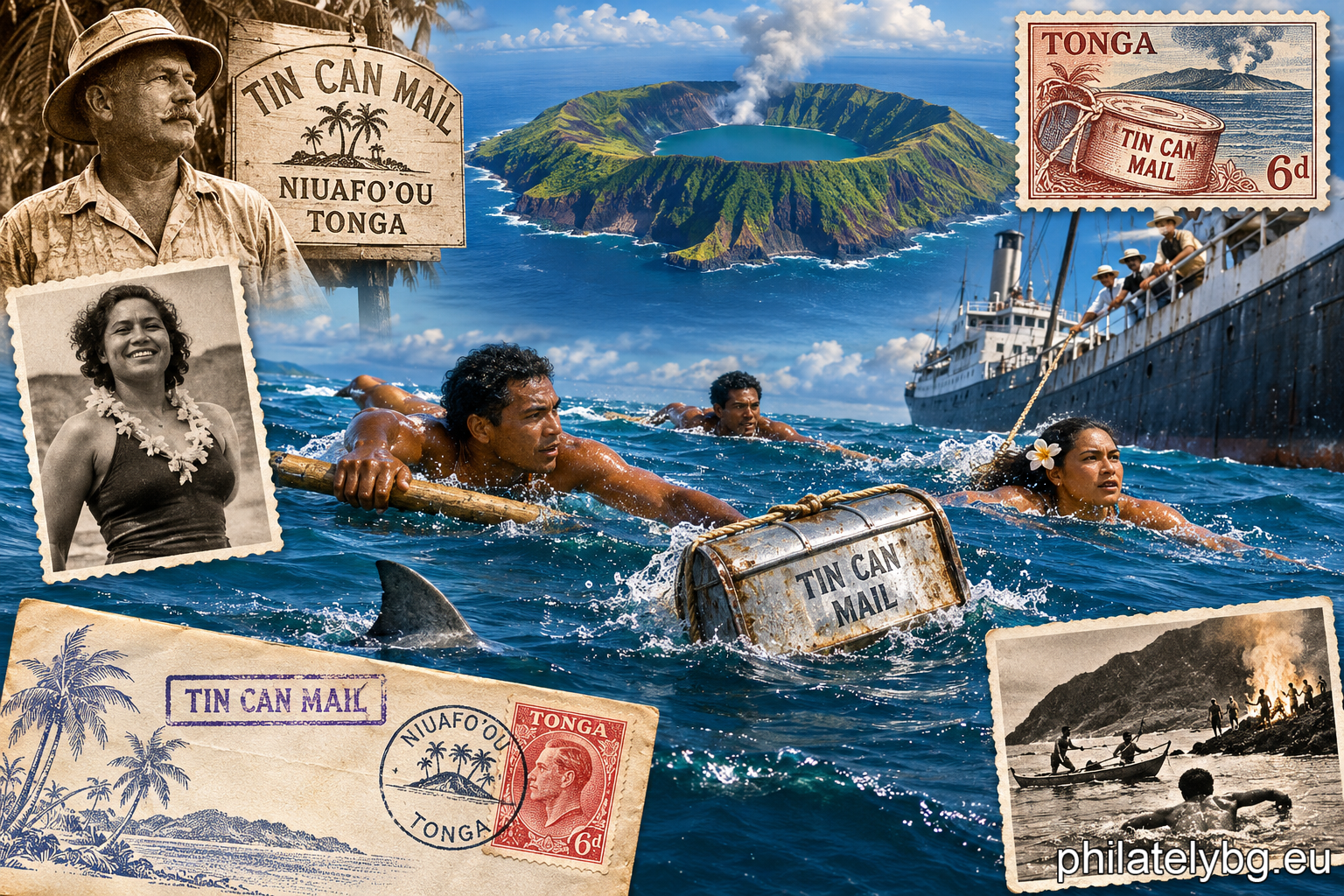
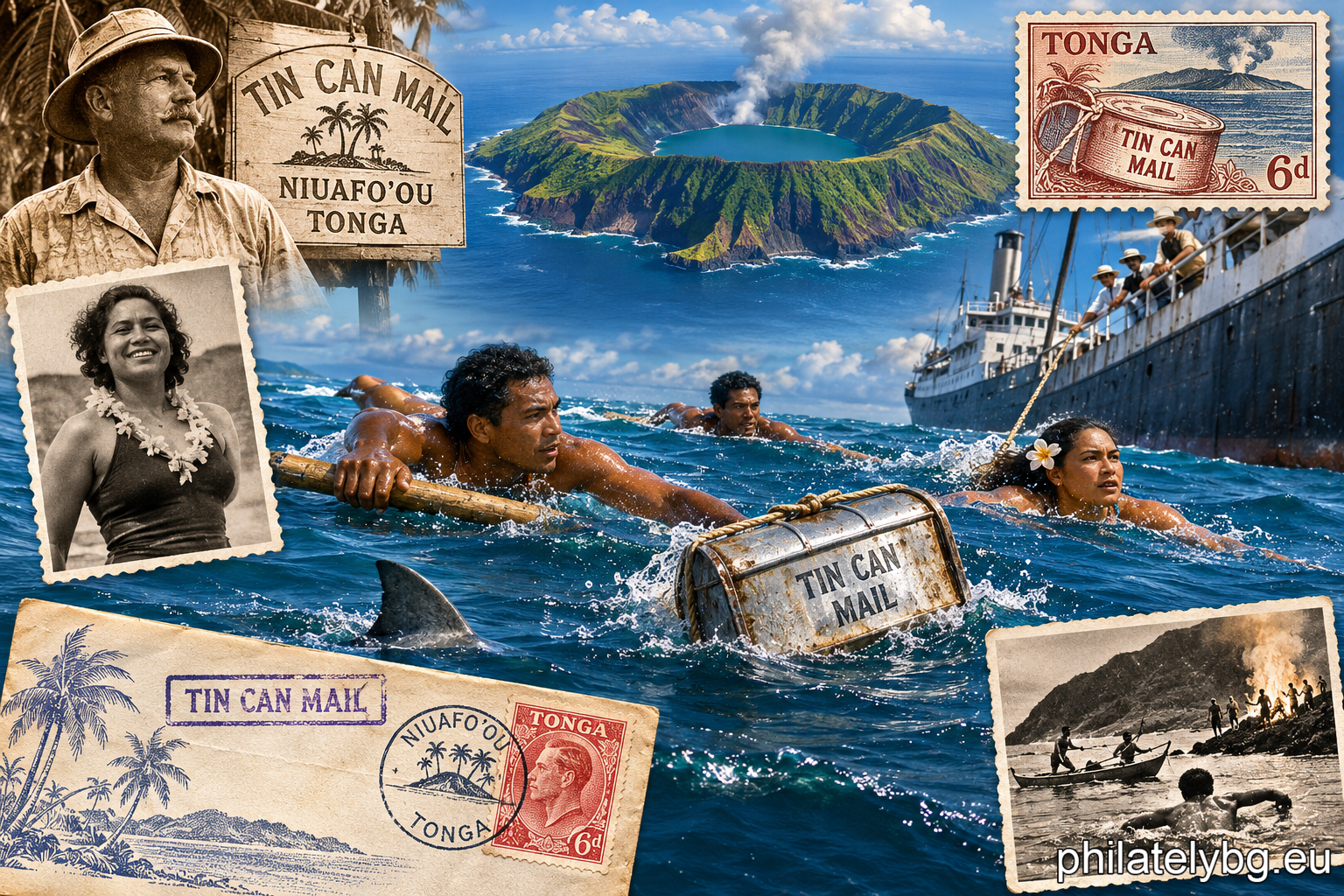
 How, on a volcanic island in the Pacific, mail was thrown from ships in sealed tins and swimmers chased it through shark waters – and how this became a dream for stamp collectors.
Imagine waiting for a letter, but the postman cannot reach you, because there is no harbour near your home and the water is so deep that ships cannot drop anchor. That was life on Niuafo’ou – a small volcanic island, the northernmost of the Kingdom of Tonga, in the middle of the Pacific Ocean between Fiji and Samoa. It is shaped like a doughnut: a crater lake in the middle, and a coast so steep that vessels cannot land. The island has an area of about 15 square kilometres.
According to most sources, the solution appeared in 1882. William Travers, a plantation manager, found himself cut off from the world and agreed an unusual plan with the Tongan postal authorities. The mail was soldered into a biscuit or kerosene tin weighing about 18–20 kilograms, so that the air inside kept it afloat. Captains of passing ships threw the tin overboard, and swimmers set out from the island to collect it. Letters leaving the island travelled the other way, swimming out to the ship.
The swim was no stroll. Islanders used a traditional fishing pole called a fau to help them float. Even a tin thrown about a mile from shore could take up to six hours to reach because of the currents. When ships passed at night, the swimmers went out with a lantern, and bonfires were lit on the shore to guide them back. One woman is known among them: Pauline Hoeft, a champion swimmer, who was the only woman to swim out for the mail.
Here the man who made this mail world-famous enters the story. Around 1928 Walter George Quensell, a German-born copra trader, arrived on the island. He saw how much interest this method of delivery could arouse among collectors. With a child’s printing set he made a rubber stamp reading “TIN CAN MAIL” and began stamping every letter with it. That is how “Tin Can Island” got its world name.
Quensell quickly built on the idea. In 1930 scientists came to the island to observe a total solar eclipse, and Quensell was persuaded to order rubber stamps made in New Zealand; in later years he created cachets in a variety of languages. Passengers on cruise ships posted their letters “in the Tin” together with 6 pence for stamps and costs, and he cancelled them on the island. By his own account, over 27 years on the island he sent more than one and a half million letters to 148 countries and territories. Collectors have recorded over 220 different markings of his, and covers marked “Tin Can Mail” are sought by collectors even today.
There was also a dark side. According to several sources a swimmer was killed by a shark in 1931, and according to Australia Post, Queen Salote afterwards banned swimming with the mail. From then on the letters were collected by canoe. Quensell himself, the businessman behind the island’s fame, according to the sources never swam out.
It was the volcano that ended that era. On 9 September 1946 a powerful eruption on Niuafo’ou buried a large part of the island in lava. About 1,200 inhabitants were evacuated to the island of ’Eua, hundreds of kilometres to the south, and began to return only in 1958. Quensell’s house and his collection of Tin Can Mail were destroyed, and he himself died in 1956. After 1958 the mail in tins was revived, and in 1962 the first new “tin can” letters were carried.
Tin Can Mail in this form ended in 1983, when an airfield was built on the island. That same year Niuafo’ou received the right to issue its own stamps, produced under the supervision of the Tongan post. Today several hundred people live on the island, and the name “Tin Can Island” remains: a reminder of a time when a letter had to swim across the ocean.
A young collector can take away several lessons. First, stamps and postmarks sometimes tell a story that no textbook contains. Second, a postal cover can be valuable not because of the stamp on it, but because of the journey it made. And third, the story began with the need to solve a simple problem: how to get a letter from the other side of the ocean.
Note: sources differ on some details. The start of Tin Can Mail is linked to 1882 (William Travers), but according to the Smithsonian museum it began around 1921 with the trader Charles Ramsay, and according to Wikipedia it was already in use by 1912. The eruption is dated 1946 (one Australian source wrongly gives 1948). The most commonly cited data are used.
Sources: Smithsonian National Postal Museum – “A Floating Mailbox”; Australia Post Collectables – “Shark nearly finished mail delivery” (Tony Shields); Journal of the Malta Philatelic Society, vol. 40(2) – on Tin Can Mail; Greene Foundation – “Tin Can Mail – Niuafo’ou, Tonga”; Wikipedia – Niuafo’ou; Postage stamps and postal history of Tonga; Britannica – Niuafo’ou; Kaniva Tonga (after Garth Rogers, Journal of Pacific History, 1981); VolcanoDiscovery; Papers Past (NZ), 1924–1946; Postcrossing Blog; Stampworldhistory.nl.